Prologue: The Second Diary
In 1948, Claude Shannon walked into a Bell Labs room full of buzzing relays and asked a childish question: what does it cost to remember?
Not to think. To remember. To keep one yesterday distinct from another yesterday when both look the same today.
We all keep two diaries. The first is the world — the stone here, the field there. The second is how the world came to be — the moment we chose this line over that line. Most universes can afford the first diary. Only a universe that can afford the second can host an observer.
This is the cost of a past.
Chapter I: Two Pasts, One Present
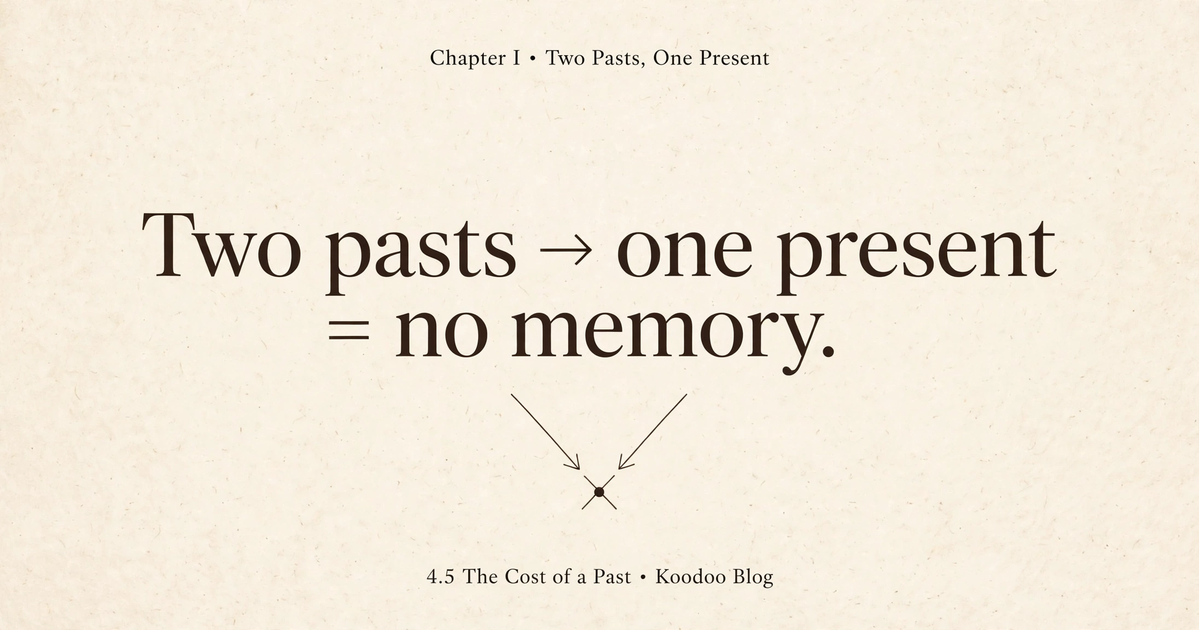
Imagine two different Tuesdays that both end with your desk looking exactly the same. Same papers, same coffee stain, same chair position. On Wednesday morning, can you tell which Tuesday happened?
You cannot. Past is fuzzy.
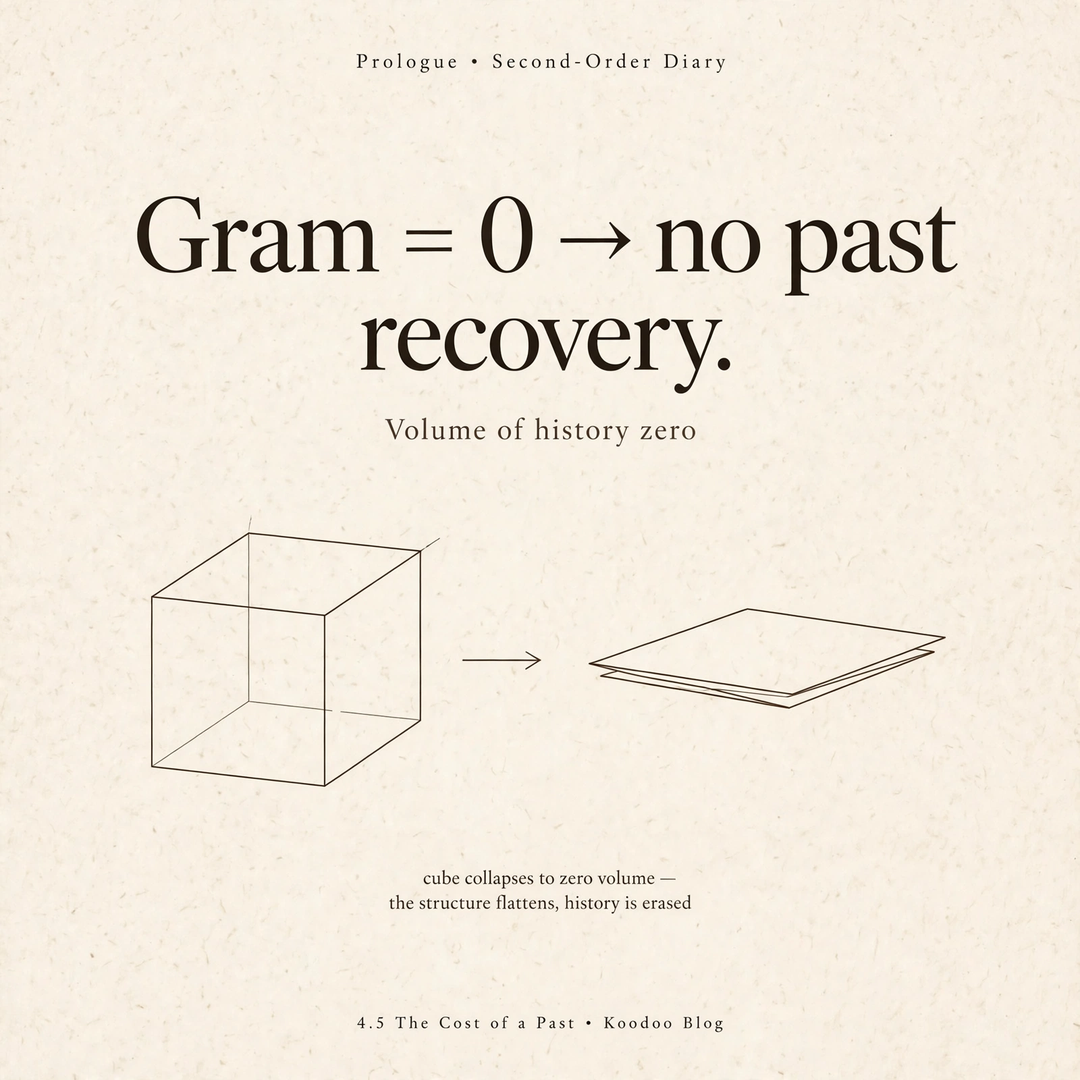
In linear algebra, the volume of history is called Gram determinant. If two histories converge to same present, volume goes to zero. Zero volume means no inverse. No inverse means present cannot be read back to past.
Your existing docs call this two scribes, one line, one page. One scribe writes “stone here”, other writes “stone there” on same line. Page smudges into nothing that says anything. That smudge is a universe with two pasts sharing one present.
Duality — Triputi — knower, knowing, known — needs that volume to be non-zero. Observer and observed can only split if past is uniquely recoverable. If past is fuzzy, there is no split. No knower, no known, no knowing.
This is why a universe that cannot encode unique memory cannot create duality. It cannot host an observer. It collapses before anyone can say “I saw.”
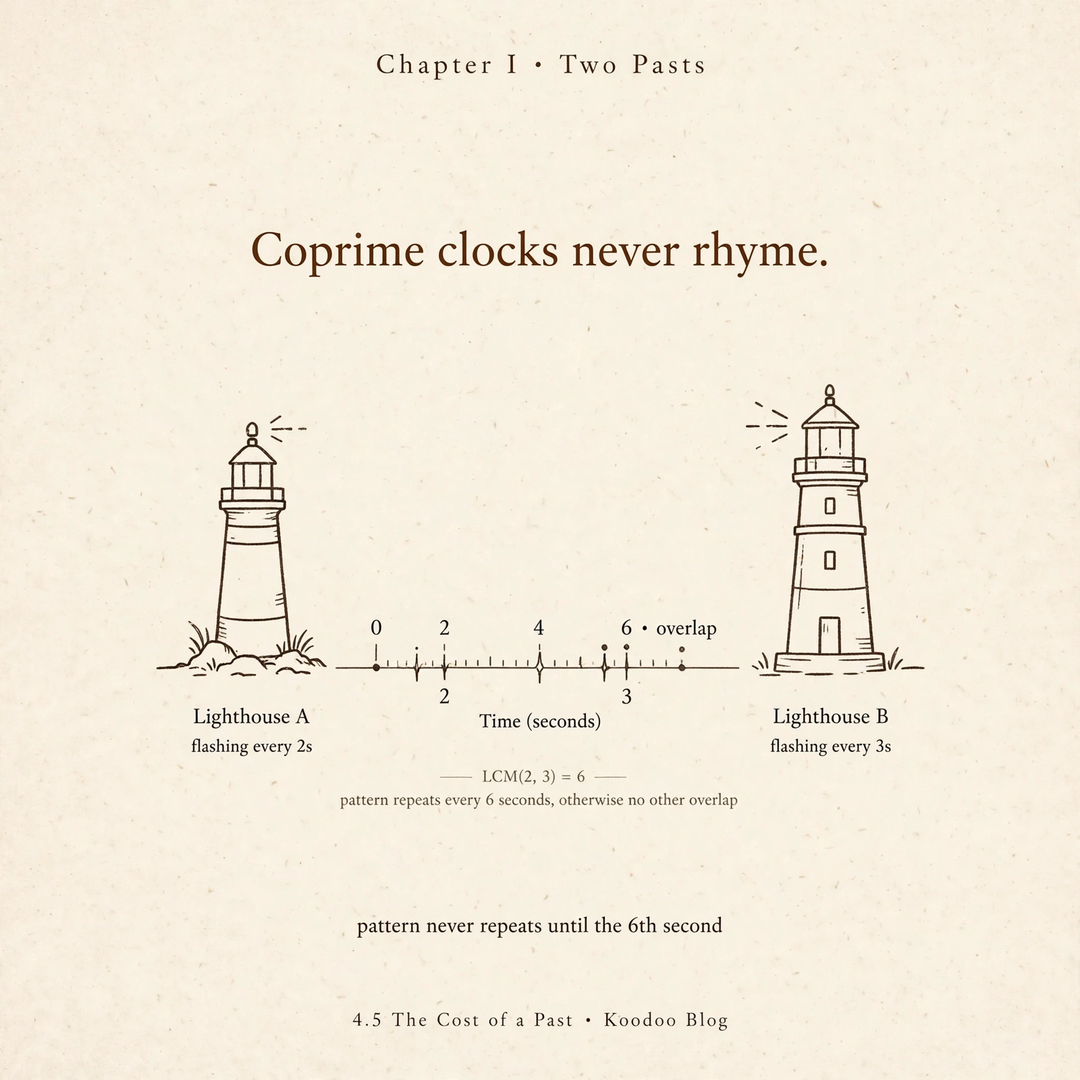
Your coprime clocks are the test: clocks built from 2 and 4 keep rhyming — same alignment again and again — you never know which Tuesday it is. Amnesia. Clocks built from 2 and 3 never rhyme — every moment has unique fingerprint. History. Memory machine.
4.1 The Wave and the Clock was never about waves. It was about this: duality needs a clock that never rhymes.
Chapter II: The Page Size
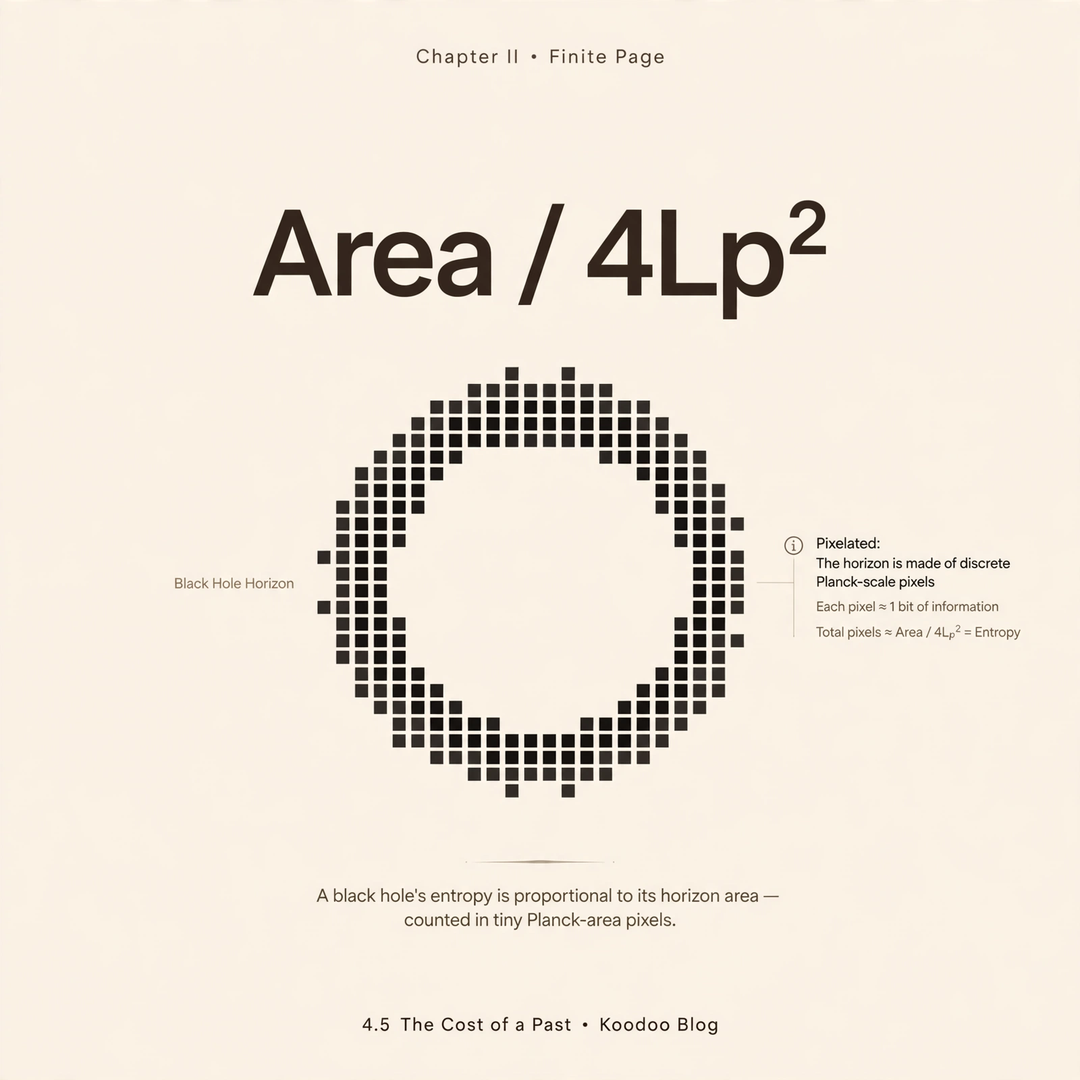
Every diary has a page size. You cannot write infinite digits on finite paper.
Bekenstein proved it: maximum bits you can store in a region is Area over 4Lp squared. Planck area is pixel of spacetime. Black hole is not exotic — it is full diary. One bit per four Planck areas.
Your treatise calls c the writing speed — one grain per tick. Observer is shutter. That is exactly right. Light speed is maximum rate diary can be written — one digit per step, never skipped page.
So page is finite. Time to write is finite. Energy to write is finite.
This is your second point: limit on encoding. Universe that forgets is not broken — it is out of paper.
Chapter III: The Price of Picking
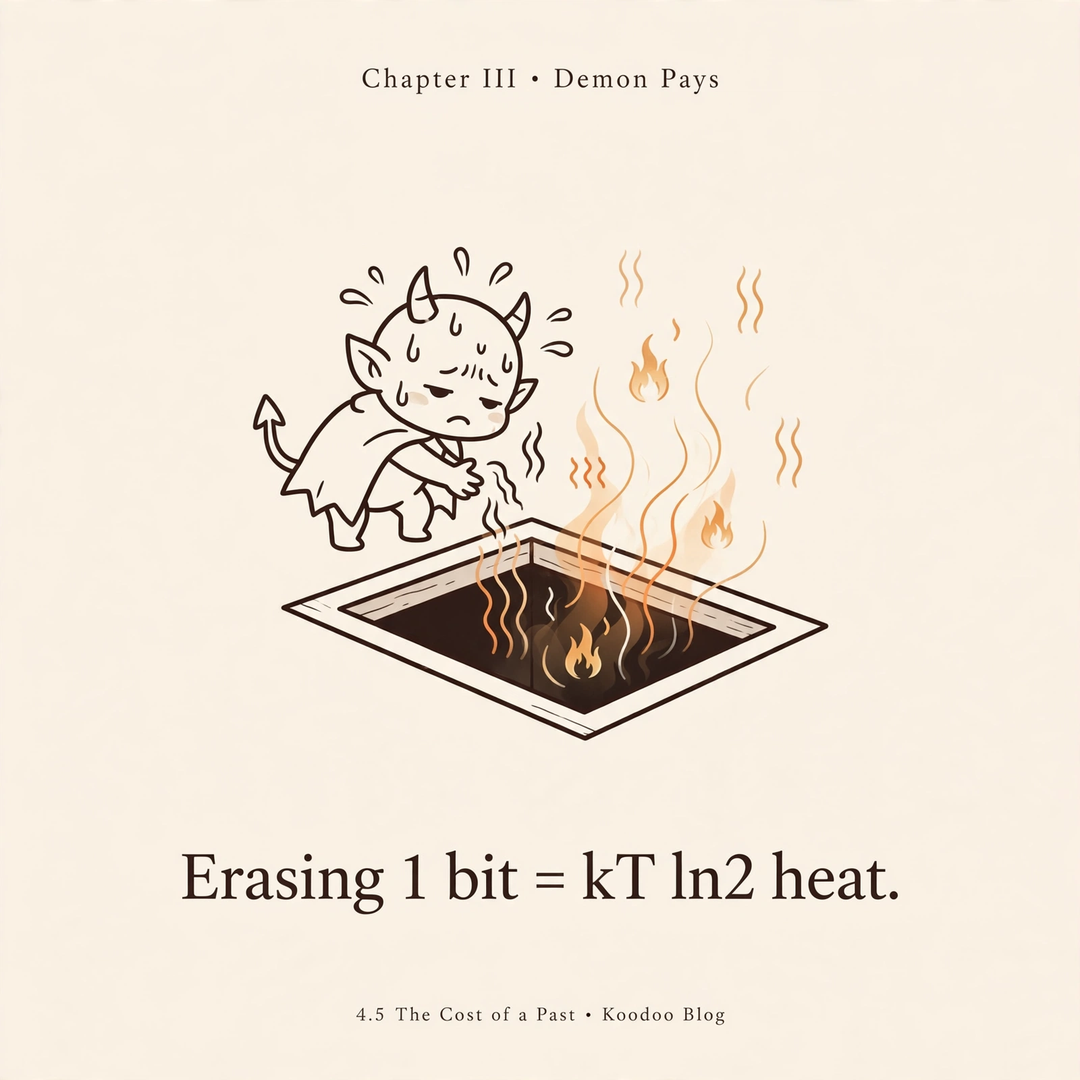
In 1867 Maxwell imagined a tiny demon at a trapdoor, sorting fast molecules left, slow molecules right, making heat flow backward. The demon seemed to break second law.
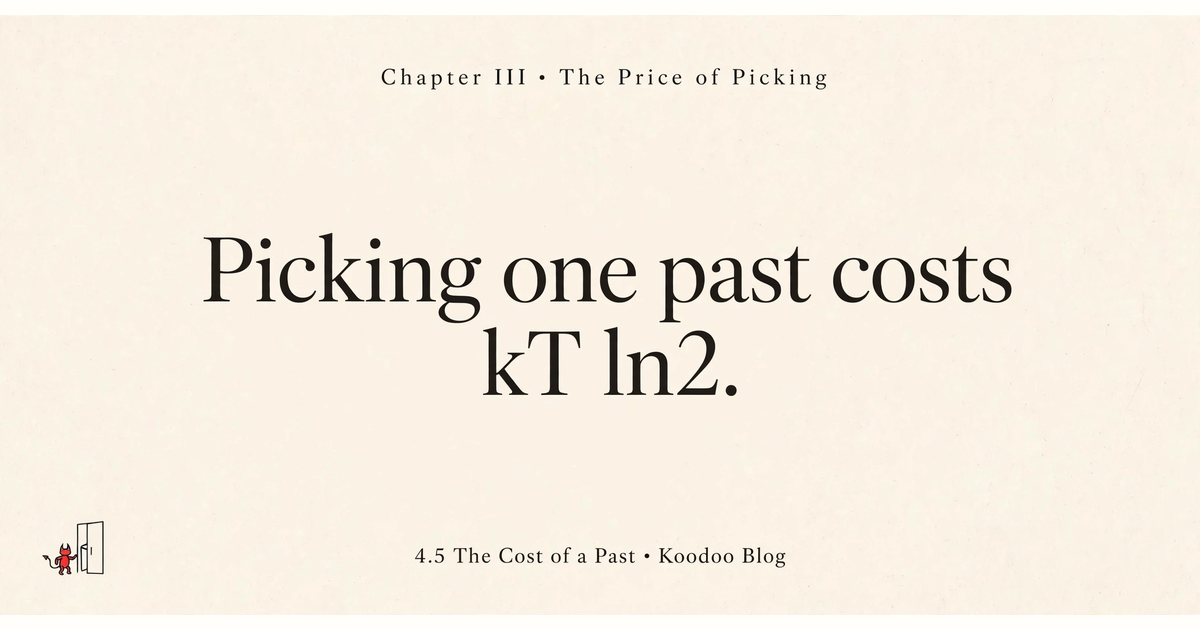
It took 100 years to see the trick: demon must remember which molecule is which. To pick one past over another, demon must erase its memory. Erasing one bit costs kT ln2 heat — Landauer’s principle. Demon pays.
Your gravity as librarian is same demon: when stone is here and there — two bends of same page — gravity must pick one pen so page stays crisp, history stays invertible, diary stays readable. Picking costs.
This is 4.2 The Demon at the Trapdoor. Demon at trapdoor does not sort molecules — it sorts pasts. And sorting pasts has thermodynamic price.
No free memory. No free duality.
Chapter IV: The Unwitnessed Collapse
Here is your most subtle point, missing from current articles:
Collapse happens all the time. Observer and observed collapse into each other. But it happens without you witnessing it.
Why? Because witnessing needs second-order diary.
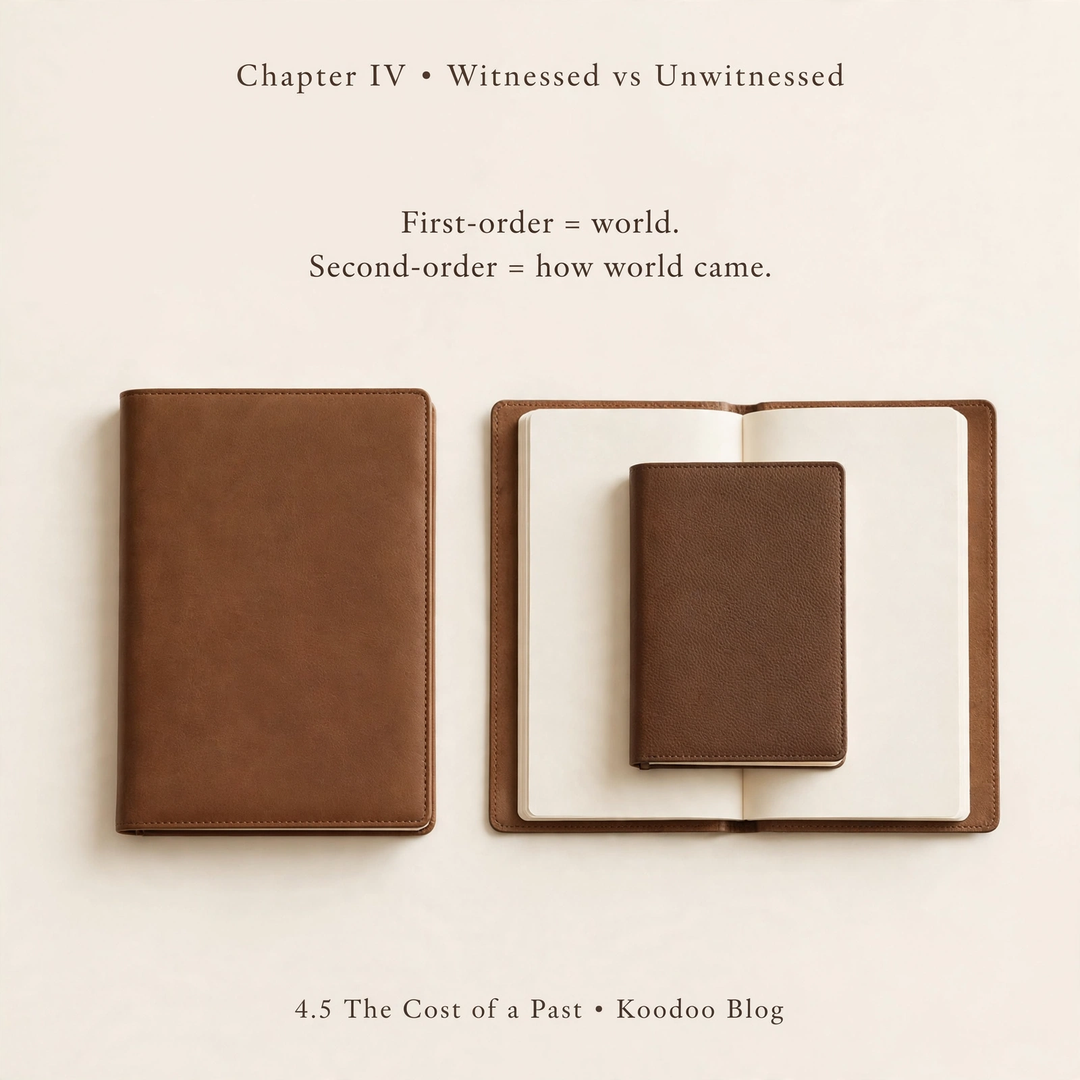
First-order diary: world is here. Second-order diary: I saw world become here from there, and that becoming came from me.
Most universes, including ours most of the time, have budget for first-order only. Collapse occurs — stone chooses here — but memory of collapse event itself is not encoded. So you experience world as always-here, not as chosen-here.
You are not witness of collapse, though you are result of it. This is everyday duality: observer appears separate from observed because you forgot the moment they were one.
Samadhi, in your context without religious language: Dharana to Dhyana to Samadhi is training to afford second-order diary. Not magic. Extra encoding budget to store event of picking itself. At that point you witness observer and observed collapse and realize collapse comes from you. You witness that duality was built, not found.
This is why if memory is not encoded properly, collapse happens without witnessing. Samadhi is witnessing this collapse.
This is also 4.3 The Unbroken Observer: von Neumann chain never breaks because no one encodes the encoding. Chain is unbroken because second-order page is missing.
Chapter V: The Monad That Writes Itself
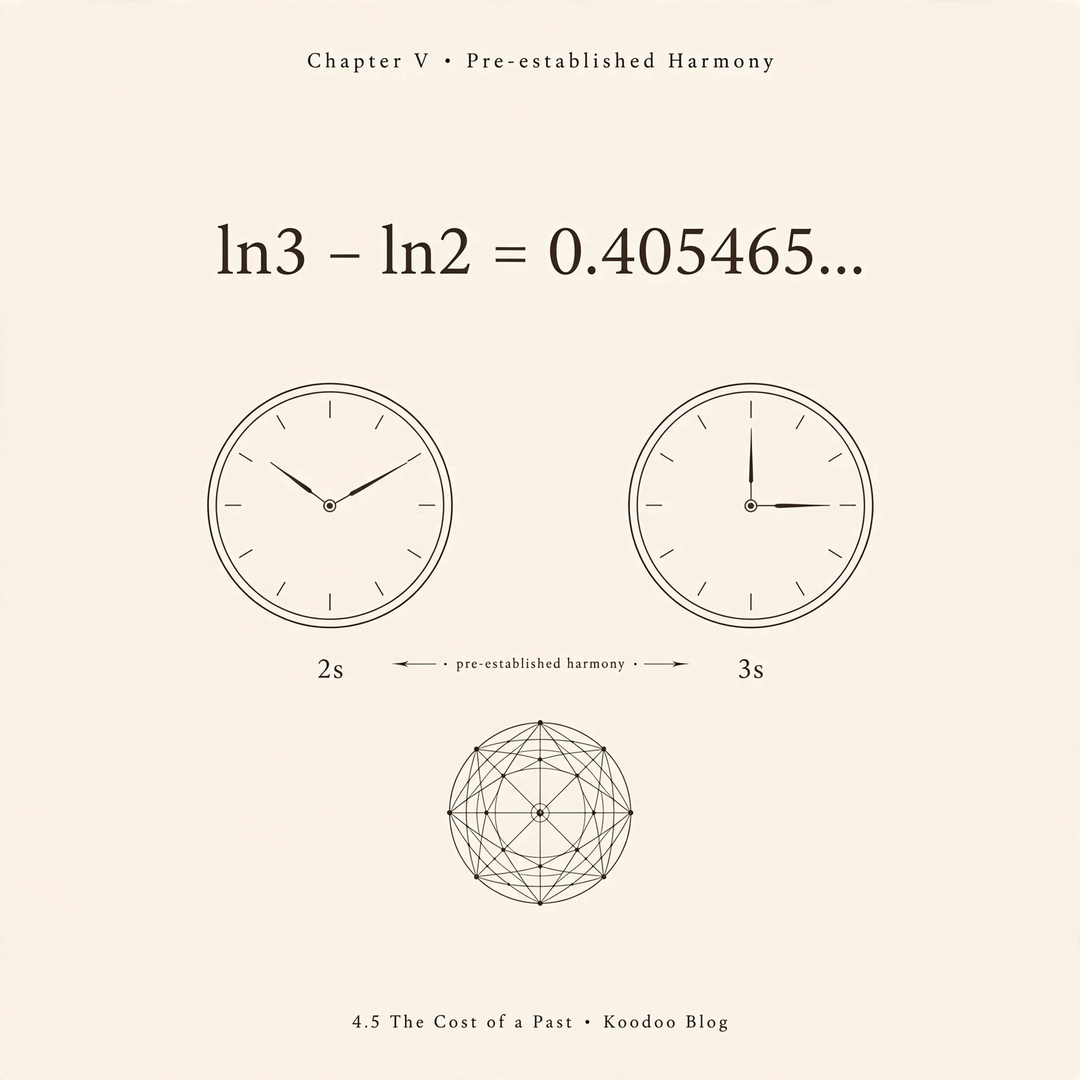
Leibniz in 1714, building Stepped Reckoner, wrote Monadology: reality is made of monads — windowless, no doors, each reflects whole universe from its own point of view. No interaction, but all monads harmonized — pre-established harmony — like many clocks wound by same watchmaker showing same time without touching.
Your thesis is Leibniz, made physical:
Monad equals memory encoder. Windowless equals cannot directly touch other pasts, only encode its own past to present invertibly. Each monad holds unique past fingerprint (2 and 3 clock).
Pre-established harmony equals ln3 minus ln2, about 0.405465. Same log distance read as quantum phase in one room and gravitational redshift in another. Same sentence, two translations. Exp and log. That is grammar that keeps all diaries consistent.
Self-luminous mirror equals monad that contains description of its own reflection function. Ordinary mirror needs external lamp — needs second light to be seen. Sun needs no lamp — self-luminous — knows itself by being itself.
Consciousness is self-luminous not because mystical, but because it is monad that has encoded its own encoding operator. It is system that stores not just M of past equals present, but stores M itself. Mirror that sees itself seeing.
This is 4.4 The Self-Luminous Mirror — closes loop: if observer needs another observer to be observed, infinite regress. Solution: observer that knows itself by being itself, no second light needed.
Epilogue: The Universe You Are Aware Of
You said: universe is creating and getting destroyed, only universe you are aware of through consciousness is where memory is encoded.
Leibniz says same: infinite monads, each with its own diary. Only monads whose Gram volume stays above zero, whose page not smudged, whose second-order diary gets written, become aware.
You are not in universe. Universe that can afford you is in you — as readable past.
And that is why a universe that forgets cannot host you. Because you are the cost of a past that was kept.