Prologue: The Bone in the Permafrost
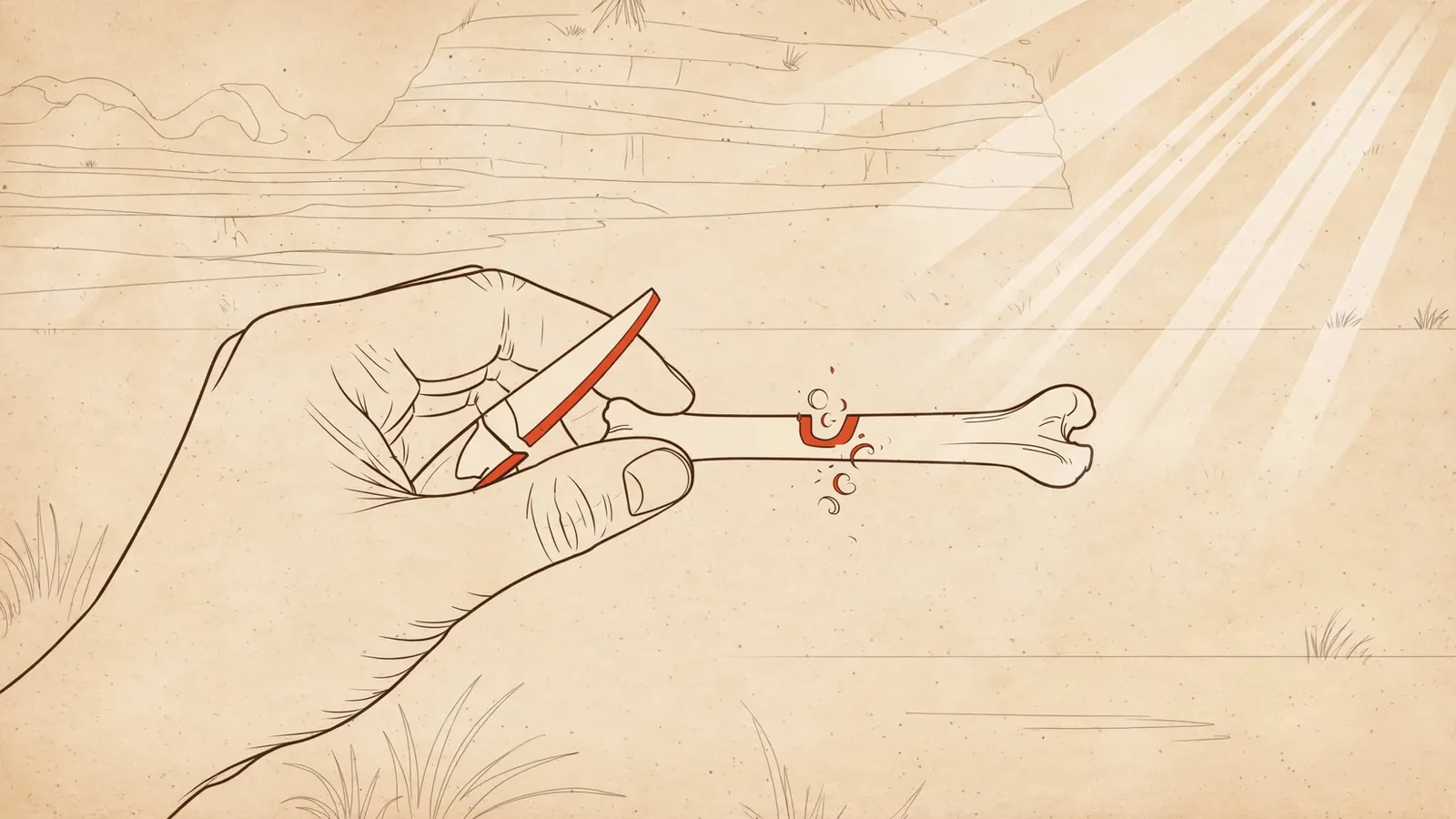
Twenty thousand years before the first merchant ship crossed the Persian Gulf, a human hand worked by the light of a dying fire in the high volcanic hills above Lake Edward, near the headwaters of the Nile, scraping a sharpened flake of quartz against the dark leg bone of a baboon. The wind blowing off the ice sheets of the European glaciers had chilled the central African highlands into dry scrub, and the herds were moving while the seasonal lakes shrank and the clan went hungry. Nobody in that camp was thinking about mathematics, because they were thinking about surviving the next week and keeping the children alive through the cold nights.
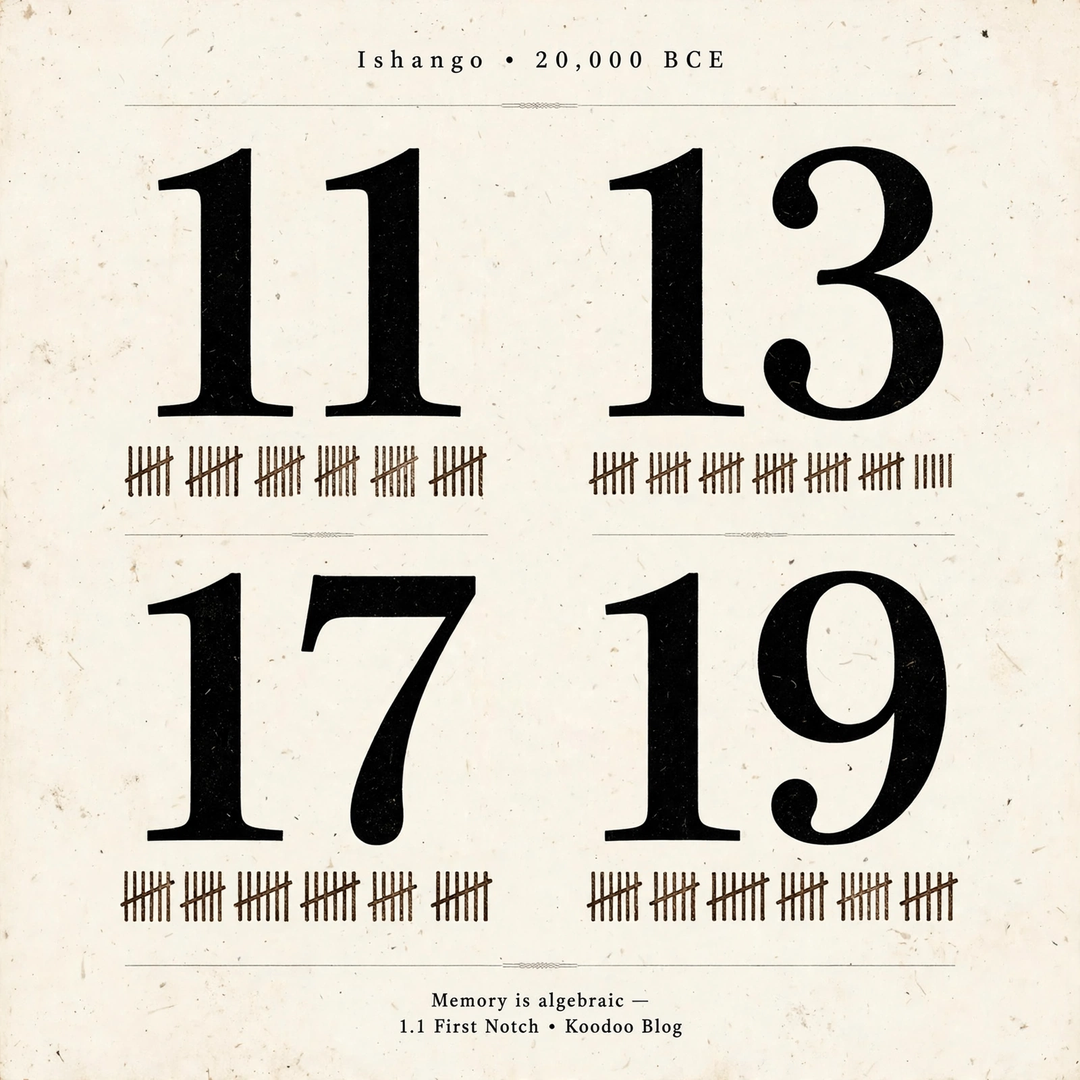
The bone survived because it was buried in volcanic ash at a fishing settlement called Ishango, and it was no ornament because it carried no pictures of antelopes or hunters. It carried three parallel columns of short cuts made with deliberate and uneven pressure, marks that were clearly counted rather than decorated. One column reads 11, 13, 17, and 19, the prime numbers between 10 and 20, while another column sets 3 beside 6, 4 beside 8, and 10 beside 5, pairings that show doubling and halving. Whoever carved those columns was keeping track of quantities that mattered, and the care in the spacing shows a mind working through relationships between numbers.
The bone was excavated in 1950 by the Belgian geologist Jean de Heinzelin, and scholars have debated ever since whether it was a tally, a calendar, or a game. That debate misses the harder truth, because no illiterate clan grinds quartz into bone for amusement while its children suffer from hunger and sickness. The carver worked because living memory had failed, and the group needed a record that would still be there in the morning when voices disagreed. The notches were cut under pressure, and pressure is the reason most of mathematics exists.
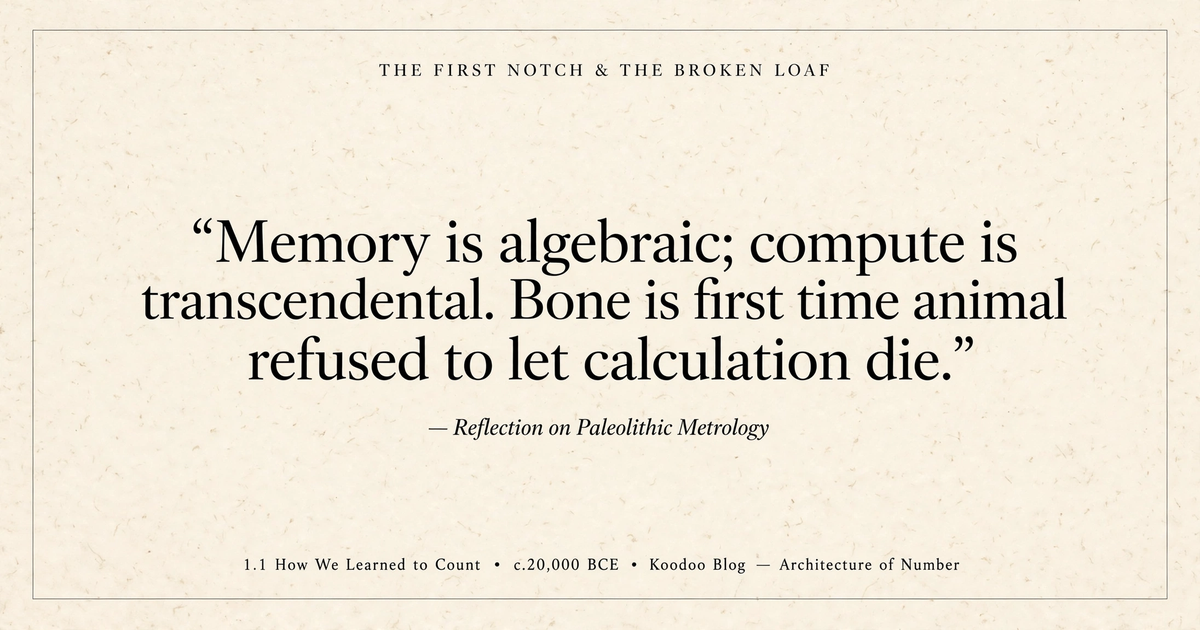
”Memory is algebraic; compute is transcendental. The living animal computes continuously through senses—heat wind scent predator arc spear. But computation vanishes with breath. Bone is first time animal refused to let calculation die.”
— Reflection on Paleolithic MetrologyBefore the notch, life ran on fragile memory carried inside the skull, and that fragility shaped every decision the clan made. A woman tracking the cycles of her own body and the shedding of blood had to carry that calendar of the moon entirely in her head, and a fever could wipe the count clean in a single night. When the herd passed through the mountain gap on the dark of the moon, hunters who arrived ten days late found an empty valley, and a winter camp without stored food could become a tomb of unburied bones. Forgetting was not embarrassment but death, and every elder knew how quickly a season could turn against a forgetful group.
The notch became the first unit of external storage ever built by a land-dwelling mind, and it was an act of rebellion against the endless flow of nature. The universe does not hand us whole numbers, because nature deals in shifting light and temperature and hunger that rise and fall without clean edges. By hacking a line into a baboon leg, the carver made a sharp discrete cut across that continuous reality and declared that this moon is one and the next is two. That frozen interval, held in dead matter, could be pointed at and argued over and trusted in a way that breath and speech never allowed.
Yet the notch could only count what already existed in front of the counter, and that limit would drive the next ten thousand years of invention. Nobody can notch a bone for an empire that has not yet been taxed, and nobody can settle a harvest by scratching lines when the task is dividing 500 bushels of grain among 47 canal diggers. The same tool cannot measure the cubic cubits of limestone in a ramp climbing toward the sky, nor can it settle a debt between two men who speak different languages. To answer those harder demands, humanity had to leave the frozen ridges and descend into the thick mud of the great river valleys.
Chapter I: The Sun on the Silt
In the fourth millennium before the common era, wandering nomadic bands in northeastern Africa found themselves trapped by a changing climate they could not control. The Green Sahara, once a lush savannah of lakes and elephants, spent five thousand years drying into an ocean of screaming sand that swallowed wells and pastures alike. Driven eastward, tens of thousands of families with leather tents and half-starved cattle descended into the narrow, mosquito-choked canyon of the Nile. They came as refugees of drought, and they stayed because the river offered a bargain of flood and harvest that no desert could match.
They found no tranquil river but an ecological machine that ran on violence and reward in equal measure. Every summer around the middle of July, the stagnant green ribbon of the Nile turned into a raging blood-red torrent fed by monsoon rains in the Ethiopian highlands, with billions of tons of water pouring down the Blue Nile and the Atbara. That flood carried millions of tons of volcanic silt into the Egyptian depression and held the valley underwater for about three months, turning mudbrick villages into islands on mounds above an inland sea. Then in late October the waters receded and revealed Kemet, the Black Land, a vast shining plain of damp black alluvial slime so rich that a farmer could broadcast wheat seed and let pigs tread the grains into the mud, then reap thirtyfold without ever touching a plow.
That miracle created an administrative nightmare every autumn, because the floodwaters brought a kind of legal amnesia along with the fertile mud. Every stone boundary, irrigation ditch, hedge, and dyke dissolved under three feet of fresh gray silt, leaving neighbors to face each other at dawn across identical black slime with bronze daggers in their hands. One man swore his field ended at the palm trunk while another swore it ended at the canal, and without trusted records the harvest rotted while taxes went uncollected and granaries stood empty. A kingdom that could not decide who owned each patch of earth would tear itself apart within a single season.
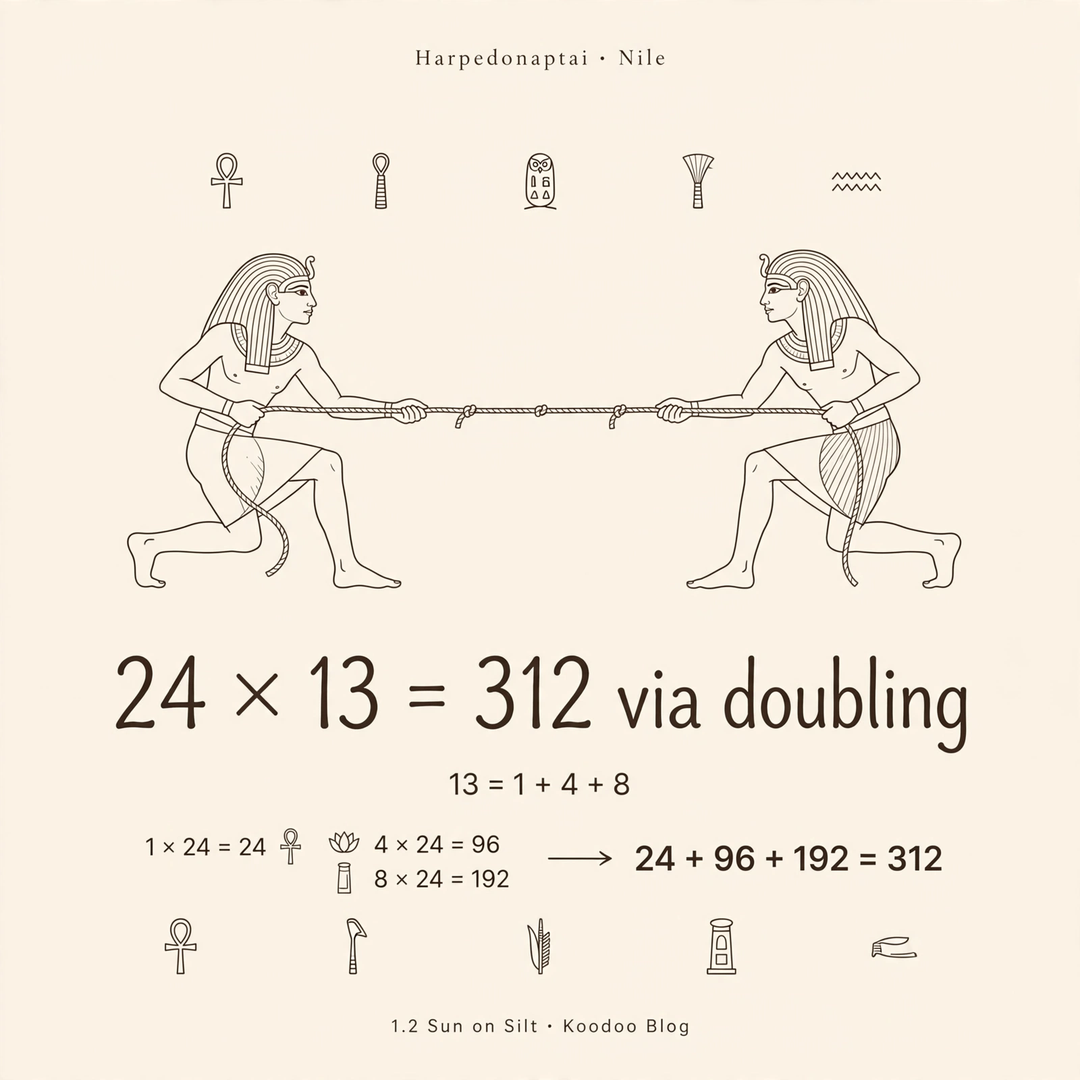
Salvation was entrusted to the Harpedonaptai, the rope-stretchers whose Greek name still describes exactly what they did in the stench of the drying mud. They were no palace officials on papyrus but working surveyors in coarse linen loincloths, walking barefoot with heavy coils of hemp cord sealed with beeswax and ox fat so the fibers would not stretch when soaked by river water. Every few cubits along the cord they tied a knotted marker, and they worked in pairs with bronze-tipped poles anchored to stakes and permanent stone benchmarks set into the limestone cliffs above the floodline. From those high marks they stretched cords down across the valley floor, which never formed tidy squares but a chaotic jigsaw of curved meanders, trapezoidal basins, and triangular gravel banks that no one could measure by pacing alone.
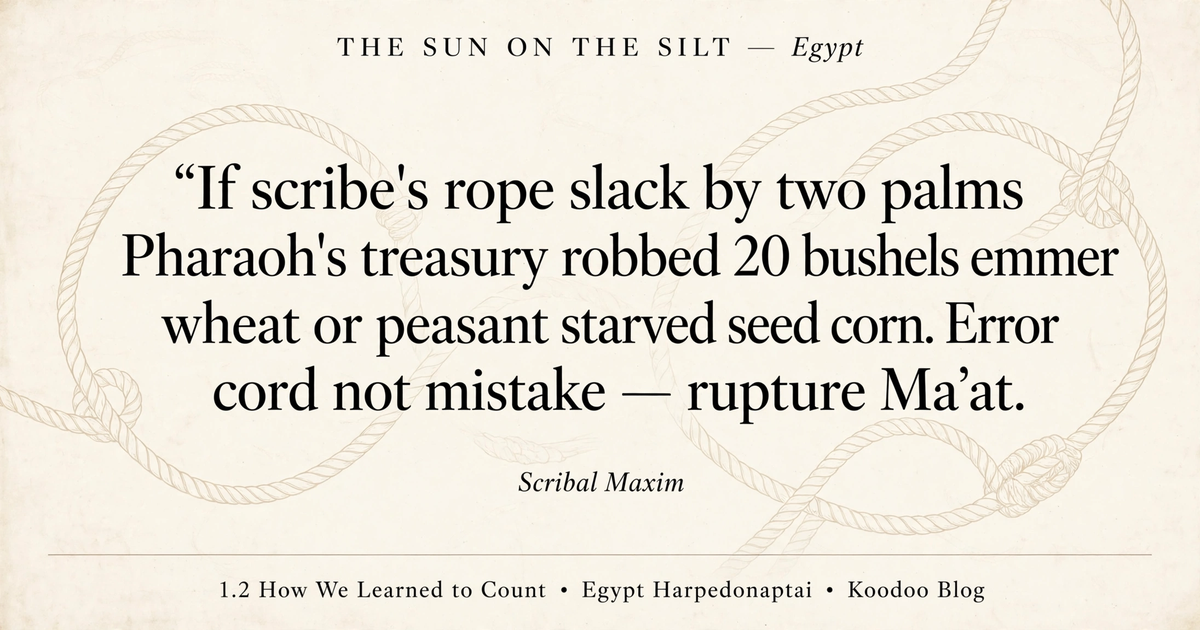
”If scribe’s rope slack by two palms Pharaoh’s treasury robbed 20 bushels emmer wheat or peasant starved seed corn. Error cord not mistake calculation rupture Ma’at.”
— Scribal Maxim Old KingdomThat warning carried sacred weight because the Egyptians believed the universe was locked in a war between Ma’at, the truth and balance and geometric rightness of things, and Isfet, the chaos and darkness and flood violence that threatened to swallow order. Pharaoh was honored as the living god Horus holding back Isfet by enacting Ma’at in every judgment and measurement across the land. To calculate a boundary incorrectly was therefore no clerical slip but a cosmic sin that tore at the architecture of the world itself. Unjust taxes and crooked fields invited disaster, for if Ma’at failed the Nile might not rise and the sun god Ra could be swallowed by the serpent Apophis, plunging civilization into night.
Their arithmetic carried the same visual majesty as their temples, built as an additive decimal system of hieroglyphs that anyone could read at a glance. A vertical stroke stood for 1, a cattle hobble for 10, a coil of rope for 100, a water lily for 1000, a bent finger for 10000, a tadpole for 100000, and a god kneeling with raised arms in astonishment for one million. The record of 324,152 prisoners from a Nubian campaign could be carved in granite as 3 tadpoles, 2 bent fingers, 4 water lilies, 1 coil, 5 hobbles, and 2 strokes, magnificent to behold but terrible for rapid calculation. To multiply, scribes used successive doubling and halving that mirrored the two hands, so 24 times 13 was laid out as paired columns reading 1 with 24, 2 with 48, 4 with 96, and 8 with 192, and since the left-side powers of two that sum to 13 are 8 plus 4 plus 1, the scribe added the matching right-side numbers 192 plus 96 plus 24 to reach 312, a binary dance of repeated addition that needed no memorized tables and rarely broke down.
Chapter II: The Bakery Riot at Thebes
In the sixteenth century before the common era, in the administrative quarter of Thebes, a scribe named Ahmes sat at a low cedarwood table unrolling a yellowed papyrus that already felt ancient in his hands. The air smelled of brewing mash and baking sourdough drifting from the royal bakeries of the Temple of Amun, while outside some two hundred bronze-miners, stone-masons, and plasterers hammered with adzes and shouted curses at their paymasters. The men were close to full revolt because the royal grain treasury had failed to deliver the monthly beer and bread stipends, even though the bins stood full of barley and spelt. The crisis was operational rather than agricultural, for the bread batches came out in irregular sizes and the beer vats varied in strength, leaving labor squads of unequal rank feeling cheated and hungry.
Ahmes dipped his rush pen in red ink and copied an older manual from the Middle Kingdom, the document now called the Rhind Mathematical Papyrus after the Scottish collector Alexander Henry Rhind, who purchased it in Luxor in 1858. Its title promises the accurate reckoning for inquiring into things, and the knowledge of all that exists, all mysteries and all obscurities, and the title inscription is dated to around 1550 before the common era. Yet the scroll holds no spells for raising the dead and no demons or philosophical speculation, only workmanlike mathematics for people who built and brewed and measured. Its 87 practical workplace exercises cover the slope of pyramid casing stones, the volume of cylindrical grain silos, tests for whether a brewer has watered the beer, and above all the fair division of bread.
The fractional crisis behind those exercises is best seen in Problem 40, the case of the hundred loaves for five starving quarry workers. The hundred loaves must be shared among five men in an arithmetic progression, with the sum of the two smallest shares equal to one-seventh of the sum of the three largest shares, and the question is what each man receives. A wrong answer meant the senior overseer might take less bread than a junior digger, and once the hierarchy of the gang broke, the tomb work ground to a halt. Ahmes had to produce shares that every man accepted as both lawful and visibly fair, with no crumbs left for argument.
His triumph grew out of a strict doctrine of unit fractions that looks strange to modern eyes but made perfect sense at the bakery door. To a modern clerk, 7 over 10 is an ordinary number between zero and one, roughly 0.7 on the number line, but to an Egyptian scribe that reading was an absurdity because a fraction was not an abstract point but the physical act of dividing an actual loaf of bread. The physical world made the numerator an illusion, since no baker can cut three-fifths with a single stroke but can cut halves and thirds and quarters and fifths, which meant only unit parts like one-half and one-third and one-quarter and one-fifth were real, with the intuitive two-thirds admitted as a fundamental operator. Mathematics had to follow the knife rather than the other way around.
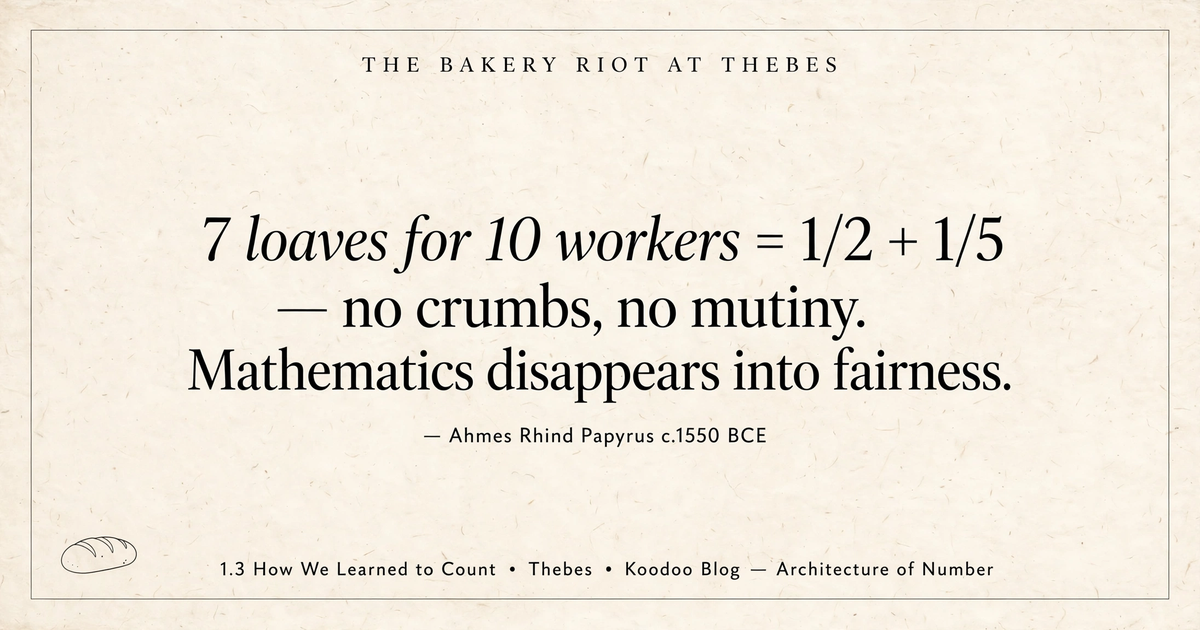
Put yourself in the shoes of Ahmes facing 7 loaves for 10 laborers, because the modern answer of seven-tenths of a loaf means nothing to a man holding a blade. Slicing each of the 7 loaves into 10 microscopic wedges would produce 7 slivers per man, and the bread would crumble into dust on the floor while the workers felt cheated and accused the overseer of stealing the crusts. Mutiny would follow the crumbs, so the scribe needed cuts that looked generous and could be checked by eye. His algorithm for decomposing unit fractions answered exactly that need with physical genius rather than abstract cleverness.
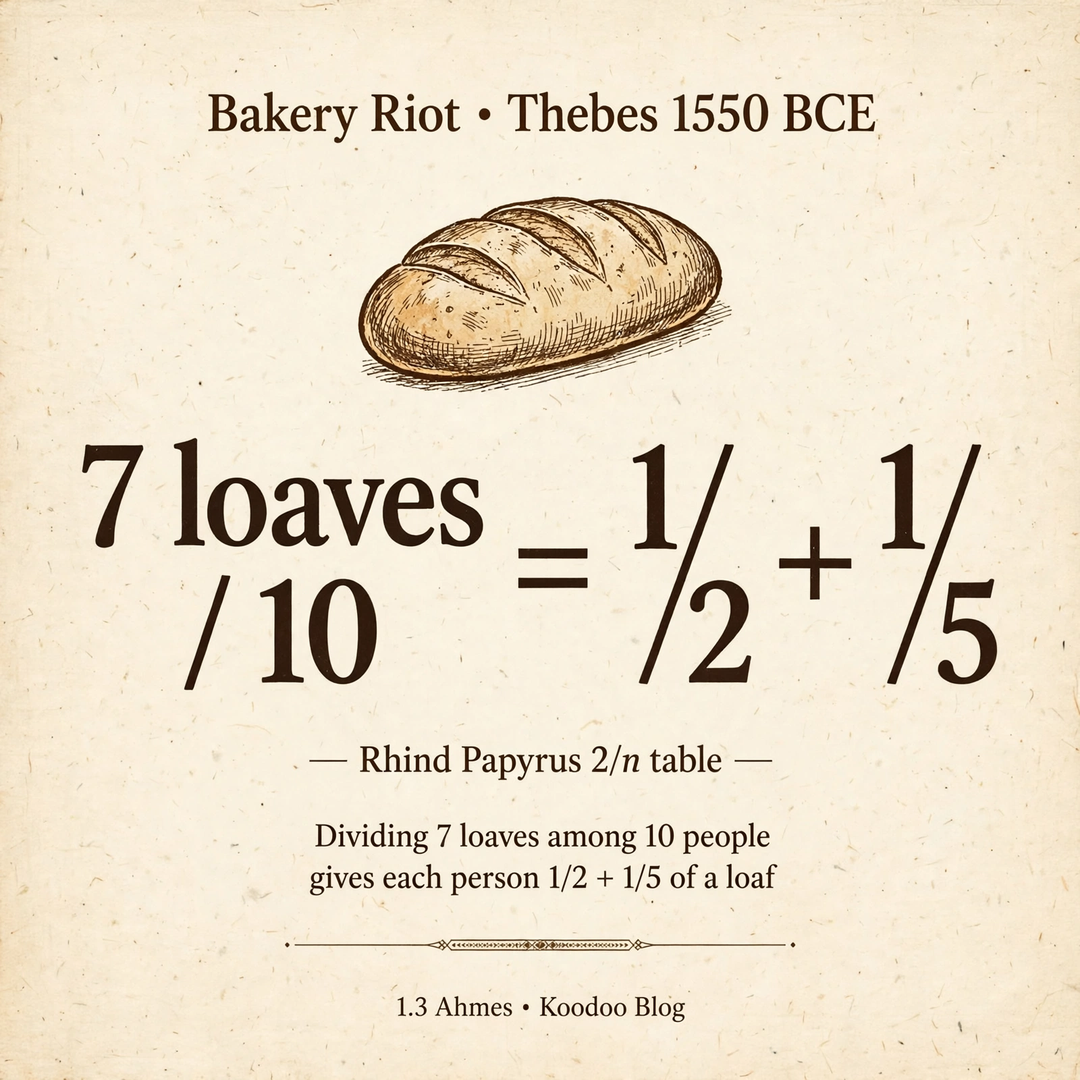
That formula meant taking 5 loaves and cutting each cleanly in half, which produces 10 substantial half-loaves so every worker receives one solid half without dispute. Then the remaining 2 loaves are each cut into 5 equal pieces, producing 10 identical one-fifth slices so every worker receives one more clean slice. Every man walks away with two respectable pieces, one half-loaf and one fifth-loaf, with no crumbs and no arguments, and the chisels strike stone again. The mathematics disappears into the fairness of the meal, which is precisely why it worked as administration.
To make such splitting instant, Ahmes devoted the first section of the papyrus to a massive reference matrix, the famous table of 2 divided by n, running from 2 over 3 all the way to 2 over 101 with each entry broken into a sum of unit fractions. Readers find entries such as 2 over 5 equals 1 over 3 plus 1 over 15, and 2 over 7 equals 1 over 4 plus 1 over 28, and 2 over 13 equals 1 over 8 plus 1 over 52 plus 1 over 104, and 2 over 97 equals 1 over 56 plus 1 over 679 plus 1 over 776. A modern student might ask why the scribes wrote 1 over 4 plus 1 over 28 instead of the simpler 1 over 7 plus 1 over 7, and the answer is an iron rule of Egyptian scribal law that forbade repeating the same unit fraction in one decomposition. Writing 2 over 7 as 1 over 7 plus 1 over 7 was judged a tautological cheat that restated the problem without giving a practical cutting recipe, so every entry had to offer distinct pieces a baker could actually slice.
That brilliance was also a prison, because scribes chained to physical loaves and visual hieroglyphs could never develop general algebraic formulas that worked for all numbers at once. Complex equations had to be attacked by trial and error through the Method of False Position, preserved in the famous Aha problems that ask the reader to solve for a quantity when two-thirds plus one-half plus one-seventh of it, added together with the whole, make 33. The scribe guessed an easy number such as 42, which divides cleanly by 7 and 3 and 2, worked through the calculation to get an erroneous result, and then scaled the guess proportionally to reach the true answer. Egypt built a magnificent mathematics of stone and grain, conservative and eternal and tuned to the solar clock of the Nile, but across the Sinai desert a different civilization was already forging an arithmetic engine of terrifying speed and abstraction.
Chapter III: The Cuneiform Gearbox
Where Egypt was a sun-drenched cathedral of eternal order, southern Mesopotamia, the land of Sumer and Akkad and Babylon, was an industrial furnace of commercial paranoia. The twin rivers Tigris and Euphrates were violent and erratic monsters rather than dependable clocks, because snowmelt in the Taurus mountains of Anatolia could arrive suddenly in late spring as catastrophic flash floods that drowned the ripening barley harvest and left settlements underwater overnight. A dyke could silt up and turn useless within 48 hours, and the flat land offered no stone or timber or metal ore, so every piece of copper and cedar and granite had to be imported across hundreds of miles through hostile territory. Survival here demanded accounting and engineering rather than ritual patience.
The gods of Mesopotamia matched the rivers, and they were nightmares beside the clockwork benevolence of the Egyptian Ra. Enlil and Inanna and Nergal and Marduk appear in the tablets as capricious and violent tyrants, and the creation story of the Enuma Elish says humans were shaped through a bloody act in which Marduk slaughtered the rebel dragon-god Kingu, severed his arteries, and kneaded his blood with red river clay to create mankind. Humanity was engineered as manual labor so the gods could rest, which meant a flood that drowned ten thousand cattle was no ethical judgment but the equivalent of Enlil suffering a migraine from the noise of human cities and deciding to wash them away. To survive under such gods, people trusted the ledger more than prayer.
The first database appeared at Uruk around 3400 before the common era, born as corporate accounting for the city-state that became the first true metropolis of fifty thousand people within brick walls. Its center was not a palace but the Eanna Temple, the house of the goddess Inanna, which functioned less as a place of prayer than as the first multinational corporation, owning hundreds of thousands of sheep and thousands of acres of irrigated barley, with workshops full of enslaved women weaving wool textiles and fleets of canal barges trading down to the Persian Gulf. To prevent embezzlement, that bureaucracy needed a permanent physical receipt for every transaction, from each basket of barley tribute to every jug of beer owed to a canal excavator.
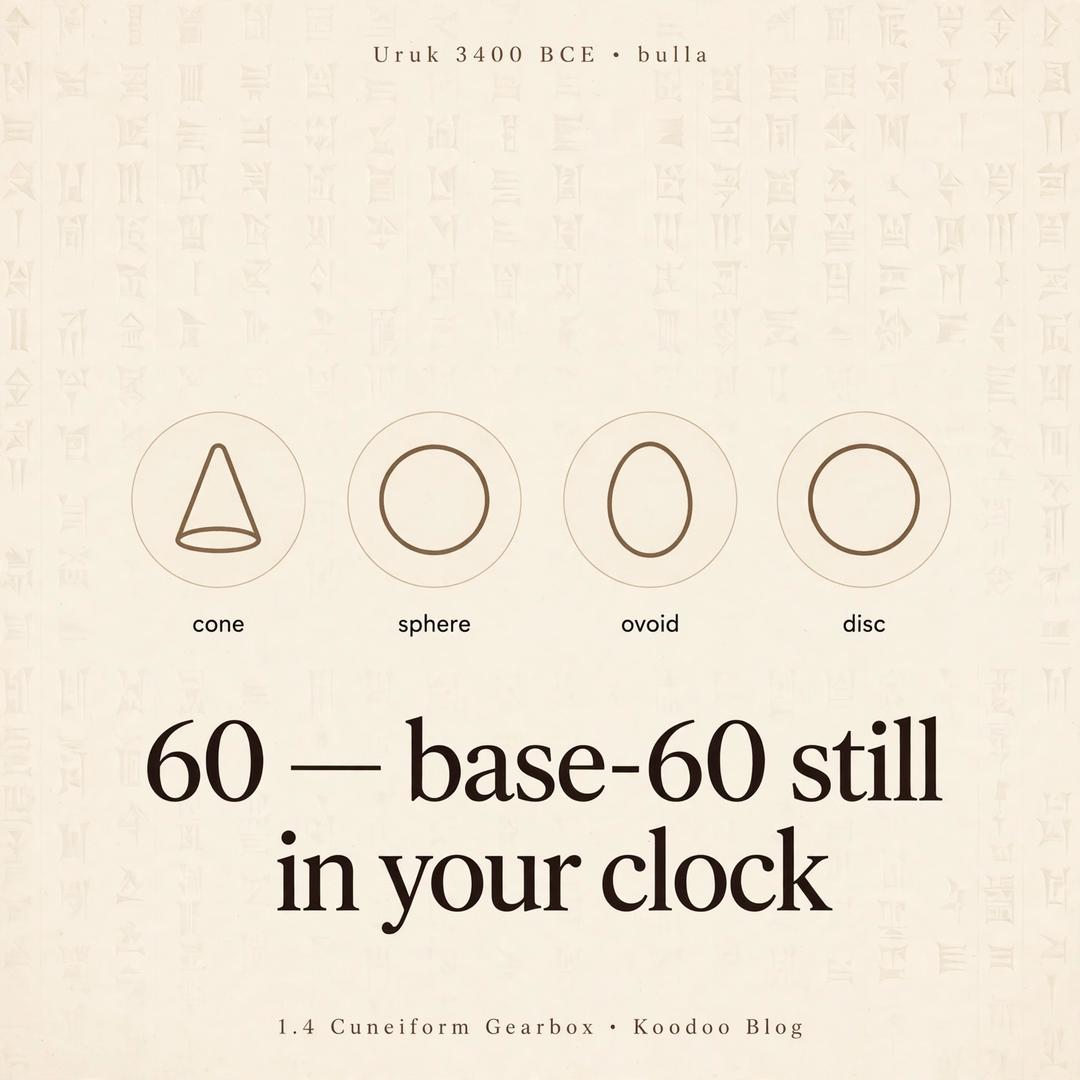
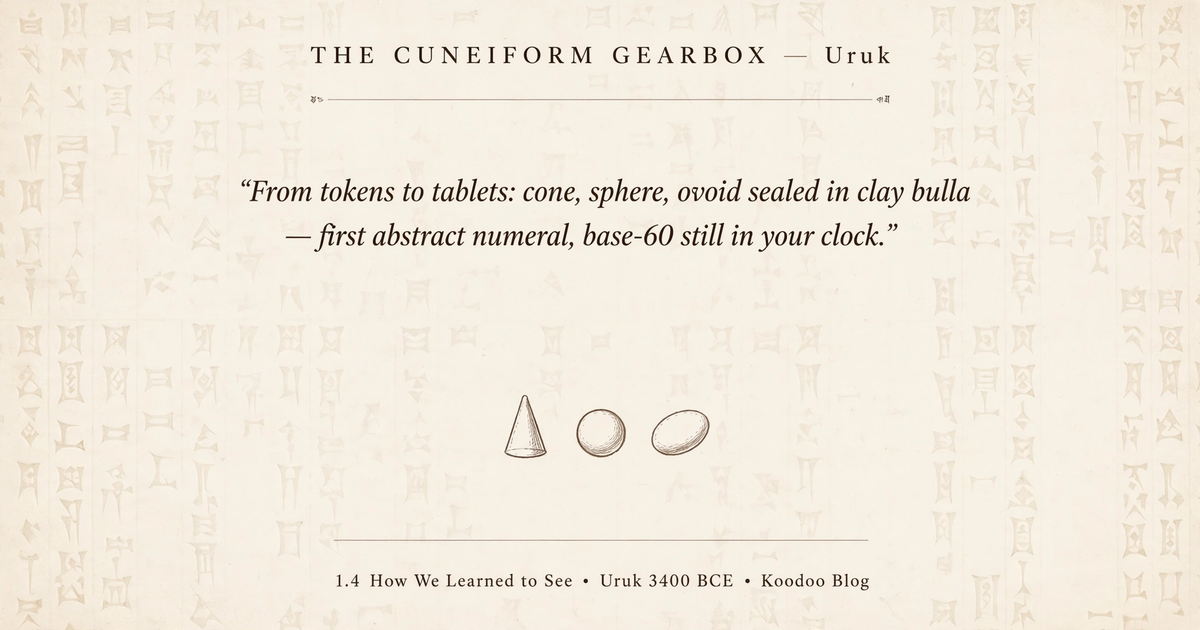
The problem was how to track transactions when neither writing nor numbers yet existed, and the temple clerks answered with ingenious three-dimensional clay tokens. A tiny clay cone stood for a small measure of grain, a sphere for a large measure, an ovoid with an incised line for a jar of sesame oil, and a disc stamped with a cross for a single sheep. When an overseer dispatched 30 sheep with an illiterate herdsman he did not trust, he gathered 30 clay sheep-discs and sealed them inside a hollow ball of wet clay, then rolled his personal carved stone cylinder seal across the wet surface and baked the ball fierce in the sun until it turned rock-hard ceramic. The herdsman could not open the sphere and steal a sheep without shattering the seal, and the receiving clerk at the destination broke the ball open, counted the ceramic tokens, and compared them against the living flock.
Around 3200 before the common era, some anonymous clerk at Uruk made the greatest intellectual leap in the history of information technology through an act of breathtaking laziness. Looking at the hollow clay ball and the reed stylus in his hand, he asked why anyone should waste hours molding ceramic sheep, packing them inside balls, baking them, and then smashing the whole thing to recover invisible tokens. Why not simply press the tokens into the soft wet clay on the outside of the ball before baking, he reasoned, and in that moment he took a cone and pressed its side into the wet clay to leave a wedge-shaped impression, then pressed a sphere to leave a flat circular impression. One gesture of bureaucratic efficiency collapsed three-dimensional reality into two-dimensional symbolic notation, and the clay balls were soon flattened into rectangular pillows of wet river mud that became the cuneiform tablet.
”Scribe does not draw picture sheep draws debt sheep. Symbol does not represent beast represents contract between temple and earth.”
— Translation archaic Uruk lexical tabletThe clerks soon realized that drawing 30 individual circular impressions wasted good wet clay, so they invented an abstract numeral mark for the number 30 and set it beside the generic symbol for sheep. In that instant, number severed its umbilical cord from matter, because the tablet no longer recorded three sheep or three loaves but carried number as an autonomous entity that could be studied in its own right. That separation made large accounts compact and comparable, and it opened the door to calculations that had nothing to do with any particular flock. Administration had accidentally invented abstraction.
The power of that administrative engine grew when Mesopotamian scribes discarded the clumsy additive system of Egypt and built the first positional place-value system the world had seen, with base sixty, the sexagesimal system that still lives in our minutes and seconds. The choice of sixty was no myth about the 360 days of the calendar but a practical and ergonomic triumph, the ultimate commercial gearbox for people who counted with their hands. Anyone can repeat the trick by looking at the right hand, where each of the four fingers carries three skeletal segments, and touching the thumb to each knuckle counts 1, 2, and 3 on the index finger, then 4, 5, and 6 on the middle finger, 7, 8, and 9 on the ring finger, and 10, 11, and 12 on the little finger, making a dozen on one hand. Each completed dozen raises one finger on the left hand, and when all five left-hand fingers stand raised, the count reaches 12 times 5, which is 60, a pocket calculator built into the human skeleton that let an illiterate canal surveyor or grain bargeman count to sixty on bare fingers while wading waist-deep in water.
More important still, sixty is a superior and highly composite number with more divisors than any smaller integer, which made division clean where our modern base ten constantly stumbles. Sixty divides evenly by twelve different whole numbers, namely 1, 2, 3, 4, 5, 6, 10, 12, 15, 20, 30, and 60, while modern base ten divides evenly only by 2 and 5. A merchant using base ten who must divide a shipment among 3 partners or 4 buyers or 6 guilds crashes into repeating decimals such as 0.333 and 0.25 and 0.166, but a Babylonian overseer in the marketplace could divide a talent of silver or a barrel of barley cleanly among 2 or 3 or 4 or 5 or 6 workers without leaving grain dust on the table. That smoothness saved hours of quarreling at every dock and warehouse in the city.
Unlike the Egyptians with their seven picture symbols for 324,152, a Babylonian scribe needed only two cuneiform wedge marks, a vertical wedge for 1 and a corner angle-wedge called the Winkelhaken for 10. By combining those wedges the scribe wrote every number from 1 to 59, and when the count crossed 60 he moved one column to the left, so the same mark in the rightmost column meant 1 while one place left it meant 60, two places left it meant 60 times 60 or 3600, and three places left it meant 216,000. The speed was blinding once the place system became habit, and scribes rarely performed long division at all because they carried standard clay tables of reciprocals, the value of 1 divided by n. To divide a tax assessment by 12, the scribe reached into the reed basket, pulled the reciprocal tablet, found the entry where 12 was written as 5 because 12 over 60 equals one-fifth in sexagesimal terms and 1 over 12 equals 5 over 60, and then multiplied, turning division into fast mechanical multiplication.
That magnificent gearbox carried one fatal phantom, because it had no zero to mark an empty place in the notation. A single vertical wedge in the second column with nothing in the first column left the reader guessing whether the value was 60, meaning 1 times 60 plus 0, or 3600, meaning 1 times 3600 plus 0 plus 0, or even the fraction 1 over 60. With no placeholder symbol, the scribe could only leave a small ambiguous blank space or rely on common sense, so a contract for cattle plainly meant 60 sheep while a grain account plainly meant 3600 bushels. When calculations grew complex across many columns, that blank space became a bottomless pit for accounting errors, and the most powerful calculator of the ancient world kept tripping over nothing.
Chapter IV: The Salt in the Furrows & The Lawgiver
Around 2200 before the common era, the ancient world was smashed by an ecological catastrophe now called the 4.2 Kiloyear Megadrought, when shifting atmospheric jet streams cut off the rains in the Anatolian mountains for generations. The drought ran for centuries across the entire Fertile Crescent, and the cities of northern Mesopotamia under the Akkadian Empire were abandoned as dust storms buried irrigation gates and hundreds of thousands of starving refugees fled south toward the marshes of Sumer. Grain panics and plague and civil war followed the failed harvests, and the old imperial maps dissolved into dust. Climate had redrawn politics before any king issued an order.
In the south, the crisis was compounded by a slower self-inflicted wound called salinization, built up over a thousand years of irrigation in a pitiless climate. Farmers poured millions of gallons of river water onto arid fields, and the blistering desert heat evaporated the water while drawing mineral salts upward from the subsoil to the surface. Slowly and quietly, the fertile black soil turned into a glittering white crust of poisonous salt, and wheat, which is sensitive to salinity, began to die in the furrows. By 2100 before the common era, wheat had vanished from Sumer and the diet was forced onto salt-tolerant barley alone, while yields plunged by seventy percent and left the cities permanently hungry.
Out of that crucible of starvation and imperial collapse came an extraordinary leader who seized the throne of the city of Ur, King Ur-Nammu, founder of the Third Dynasty of Ur, reigning from about 2112 to 2095 before the common era. Amid the smoldering ruins he grasped a fundamental truth of statecraft, which is that when food grows scarce no empire can survive on ideological charisma but only on unbending and enforceable measurement. Provincial governors were corrupt, with every market town keeping its own crooked stone weights, while tax collectors used heavy weights when receiving grain and light ones when issuing rations, and merchants shaved their silver rings to cheat illiterate widows. Without honest measure, every reform was a speech and every granary a rumor.
Ur-Nammu therefore opened the first legal code in history not with grand religion or conquest but with metrology as state law, an imperial audit of weights and measures set down as justice itself. His prologue declares that he established justice in the land, banished curses and violence and strife, and then standardized the copper se-measure of the grain bushel to thirty sila, the stone mina of weight to sixty shekels, and the silver shekel against the mina. For the first time in history, an error in calculation was made an explicit crime against the state rather than a private mistake between traders. The bushel and the balance became instruments of peace, and cheating the measure meant defying the king.
Ur-Nammu backed that metrology with an iron fist by establishing the royal Edubba tablet houses, the first formal scribal academies the world had known. Young boys from aristocratic and merchant families were taken around age six and seated on backless clay benches from sunrise to sunset under brutal discipline, where an error in a canal slope or a misspelled cuneiform sign earned a beating with wooden sticks. A surviving schoolboy text still complains that his teacher said his hand was not good and caned him, that the courtyard overseer asked why he talked without permission and caned him, and that the guardian of the gate asked why he went out without permission and caned him. The system was Spartan and often cruel, yet it produced a class of calculators who could hold an empire together.
Out of that brutal scribal culture came mathematics of staggering technical sophistication, and by the reign of Hammurabi of Babylon from about 1792 to 1750 before the common era, the tablet houses were solving problems that modern students do not meet until high school algebra. Because fertile plots along the canals were shrinking under salt encroachment, palace surveyors could no longer assume simple rectangles when redistributing land, and they had to calculate trapezoidal and triangular plots with exact fairness. The famous tablet BM 13901 in the British Museum preserves a series of pure abstract geometric puzzles that mark the birth of quadratic equations.
The Babylonian scribe owned no symbolic algebra with letters and plus and equals signs, yet solved that equation by a visual geometric algorithm called completing the square. He imagined a literal physical square of side x, pasted a rectangle of width two-thirds onto its edge, sliced that rectangle in half into two strips of width one-third, and moved one strip to the bottom of the square, where he saw the missing corner needed to complete a larger square. That tiny corner had area one-third squared, which is one-ninth, so he added that area to both sides of the account, took the square root with the help of a reciprocal table, and derived the exact and infallible solution x equals 0;30 in sexagesimal notation, which is 30 over 60 or one-half. Geometry did the work that symbols would later make routine.
Even more breathtaking is Plimpton 322 from around 1800 before the common era, long dismissed as a routine ledger until modern mathematicians looked closely at its battered clay. The tablet holds a table of fifteen rows of numbers satisfying the relation a squared plus b squared equals c squared, the Pythagorean triples that include small cases such as 3, 4, and 5 alongside giants such as 119, 120, and 169 and even 4961, 6480, and 8161, all calculated with flawless accuracy a thousand years before Pythagoras was born. The Babylonians were not drawing triangles for their own sake but using sexagesimal reciprocal pairs to compute exact trigonometric tables for temple engineering and canal surveying. The cuneiform tablet was no longer a receipt for sheep but an intellectual engine peering into abstract geometric space, even as another river civilization across the ocean discovered that the greatest power of mathematics lay not in solving quadratic equations for kings but in building an unshakable and universal foundation of trust.
Chapter V: The Silent Consensus of the Indus
Between 2600 and 1900 before the common era, while Egyptian pharaohs were stacking limestone at Giza and Akkadian kings were drowning Mesopotamia in blood, the largest civilization on Earth was flourishing across the vast basins of the Indus and the ancient vanished Sarasvati, known today as the Ghaggar-Hakra. Its cities included Harappa and Mohenjo-daro and Dholavira and Rakhigarhi and Lothal, names that still anchor digs across two modern nations. Spanning more than one million square kilometers and dwarfing contemporary Egypt and Mesopotamia combined, the Indus Valley Civilization presents the most haunting enigma in archaeological history, because its scale is matched by its silence about kings.
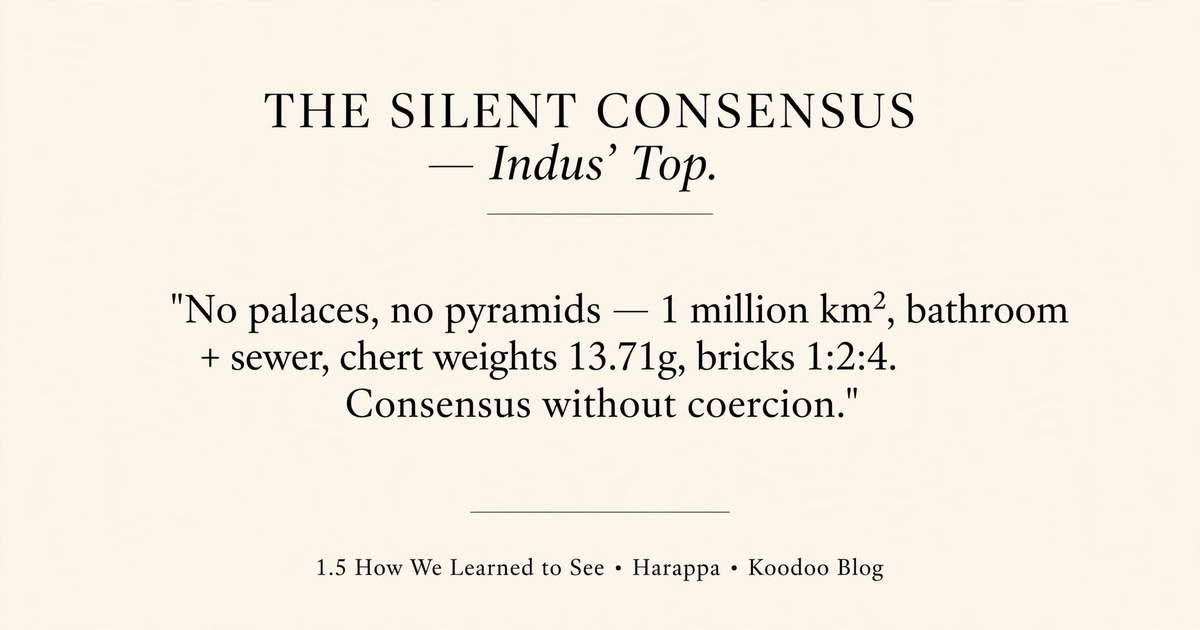
Walk through the ruins of Mohenjo-daro and Harappa today and search in vain for the monuments that define every other Bronze Age empire. There are no soaring stone pyramids and no royal tombs crammed with gold jewelry and slaughtered concubines, no basalt steles carving pictures of kings gouging the eyes of defeated captives, no giant temples towering over impoverished slums, and no barracks built for imperial armies bristling with bronze spears. Instead archaeologists have unearthed the most sophisticated and egalitarian municipal engineering of the ancient world, an architecture of equity expressed in drains rather than thrones. At Mohenjo-daro every house, from the largest merchant residence to the most modest two-room artisan dwelling, contained its own private brick bathroom connected to a city-wide underground sewer system, and beneath the wide straight avenues ran covered terracotta drainage channels with inspection manholes and silt-settling sumps that municipal sanitation workers emptied daily. Nothing comparable in public hygiene would be seen in the Western world until the imperial Roman aqueducts two thousand years later.
How did a vast and decentralized subcontinent govern itself across an empire stretching from the snows of Afghanistan to the Arabian Sea without kings or weapons or monuments. The answer was found not in a palace but in a small leather pouch beside an artisan workbench, holding a cubic chert stone weight. At every Harappan settlement excavated across thousands of miles, from the border garrison in Gujarat to the port on the Makran coast near Iran and the manufacturing city on the Ravi River in Punjab, archaeologists have found thousands of identical and beautifully polished cubes of hard dense silicate rock called chert. When those stones were brought to modern laboratories and weighed on microgram-sensitive digital balances, the result stunned the scientific world, because the weights matched across the entire subcontinent.
A weight of 10 grams found at Lothal on the shores of the Arabian Sea proved accurate within fractions of a percent when compared with a 10-gram weight found at Shortugai, fifteen hundred miles away on the banks of the Amu Darya river in northern Afghanistan. That metrological consensus exceeded the precision of eighteenth-century European nation-states, achieved without a central mint or imperial inspectors. The mathematical architecture behind the stones was a triumph of pragmatic elegance, a hybrid binary-decimal system that served small traders and great merchants at the same time.
”Indus merchant did not balance scales by royal decree balanced scales by civil consensus. Trust not enforced sword trust cast into stone.”
— Reflection on Harappan Urban MetrologyThe sequence of chert weights followed a strict mathematical progression that any balance-beam user could learn by handling the stones. The smaller everyday denominations advanced by doubling in binary fashion through 1, 2, 4, 8, 16, 32, and 64, with the base unit labeled 16 on the relative scale weighing approximately 13.71 grams. Once the scale crossed the number 16, where the traditional counting of a dozen-and-a-third survived in Indian commerce for five millennia as the 16 annas of the rupee system, the progression shifted cleanly into decimal steps of 160, 200, 320, 640, 1600, 3200, 6400, and 12800. That binary-decimal fusion was an engineering masterpiece, because the binary lower registers let an ordinary fishmonger or vegetable vendor divide food by half and quarter and eighth on a simple balance beam without touching fractions, while the decimal upper registers let a wholesale merchant trading thousands of pounds of copper ingots or carnelian beads or cotton bales beside the dockside galleys perform large-scale accounting through effortless decimal addition.
The same metrological obsession extended to fabric and buildings, where every brick manufactured in the Indus, whether lining a peasant domestic well or the great dock basin at Lothal or the defensive flood walls at Harappa, was molded and kiln-fired to an unyielding universal proportion.
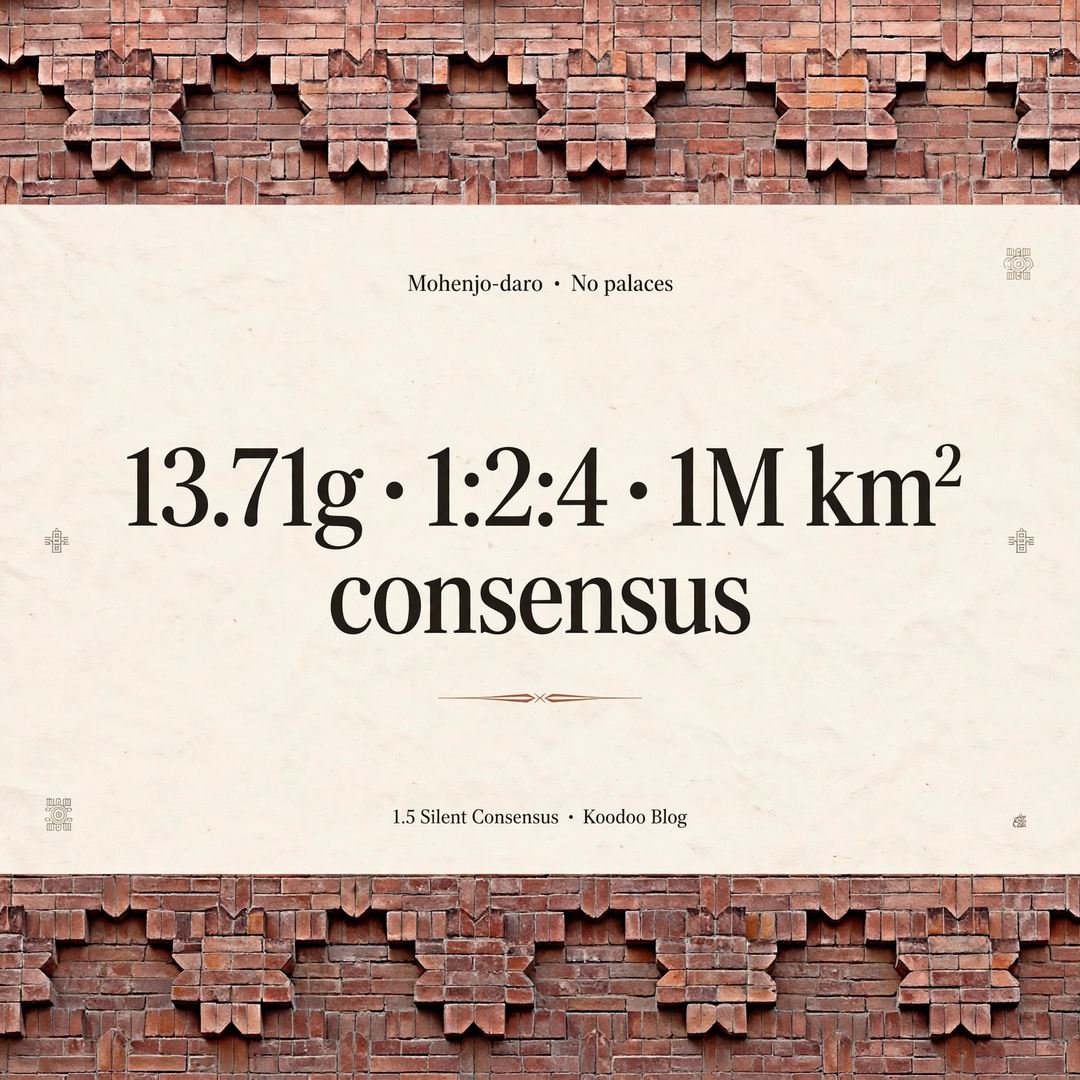
Typical bricks measured 7 centimeters by 14 centimeters by 28 centimeters, or the larger 10 by 20 by 40, and the ratio was chosen because a brick whose width is exactly twice its thickness and whose length is exactly twice its width can be laid in interlocking alternating courses of headers and stretchers without a single weak vertical seam. Those walls carried immense structural integrity against the violent lateral pressure of seasonal monsoon floods, turning a simple ratio into flood insurance for whole cities. The Indus Valley proved that mathematics did not require a bronze-sword tyrant or a bloodthirsty dragon god to achieve global scale, because standards alone, silent and invisible, held together a peaceful commercial commonwealth across a continent.
Chapter VI: The Altar of the Wheel
As the Harappan cities slowly dissolved around 1900 before the common era under the combined pressure of tectonic shifts and the drying of the Sarasvati River, the intellectual center of gravity in northern India migrated eastward into the lush rain-drenched forest clearings of the Gangetic plains. There, among Vedic clans, number returned to its sacred and cosmic origin in the sacrificial fire altar. To understand the mathematics of the Vedic world, a modern reader must abandon the Cartesian view of space as a cold empty stage, a passive three-dimensional grid extending indefinitely while observers plot points upon it.
The Vedic mind, formalized in the philosophical schools of Sankhya, which literally translates as enumeration and categorization by number, and in the hymns of the Rigveda, saw space not as emptiness but as a living and vibrating field governed by Rta, the immutable and rhythmic cyclical course of the cosmos. The universe was no machine assembled from dead parts but an unending revolving wheel of time called the Kala-Chakra. In the first mandala of the Rigveda, hymn 1.164.48, the seer Dirghatamas sings of that cosmic clock in words that still read like astronomy, saying the wheel carries twelve spokes and three navels and asking who can understand it, then adding that 360 pins are set in it and do not loosen in the least. Here the solar year of twelve months and three seasons and 360 days was understood not as a flat calendar on a wall but as a rotating wheel whose angular motion drives the life of the world.
Inside that cyclical cosmos, the fundamental operation was not moving forward along a line, because addition itself was rotation. When one day is added to thirty days, the count does not travel to a thirty-first day in empty space but completes a cycle of the moon and returns to the beginning. Time and energy and matter operated under the logic of cycles and remainders, a continuous traversal of angle driven by perpendicular momentum, so that just as an arrow shot horizontally across the sky curves beneath the perpendicular pull of gravity into a dynamic orbit, the universe stayed alive only because it kept spinning. Number therefore belonged to rhythm before it belonged to the straight ruler.
That dynamic rotational vision met the physical earth in the Sulba Sutras, the ancient manuals of ritual geometry attributed to master craftsmen such as Baudhayana and Apastamba and Katyayana around 800 to 500 before the common era. The word Sulba derives from the root sulv, meaning to measure or to rope, and the Sulba masters were heirs of both the Harappan bricklayers and the Vedic astronomers, architects who constructed the great Agnicayana fire altars. Their ritual mandate carried terrifying geometric rigidity, because a mistake in the altar was an offense against the order that held the seasons together.
”Gods are jealous of line. If altar earth transformed altar sky and its soil diminished breadth grain mustard sacrificer shall be stricken blindness or cattle shall perish night.”
— Apastamba Sulba Sutra Section IIA patron king or wealthy cattle chieftain who commissioned the great Agnicayana sacrifice to restore cosmic harmony and ensure the survival of his clan had to provide three distinct hearths burning through the night. The Garhapatya, the domestic fire of the householder, was built as an unbaked circular hearth representing the terrestrial Earth, while the Ahavaniya, the sacred fire of the eastern offering, was built as a strictly square hearth representing the celestial Heavens, and the Dakshinagni, the southern defensive fire, was built as a semi-circular crescent hearth standing as the atmospheric shield between them. Here arose the mathematical knot that gave birth to Indian geometry, because those three altars, despite their completely different shapes, were required to possess exactly the same surface area, traditionally one square purusha, the height of a man with arms upraised.
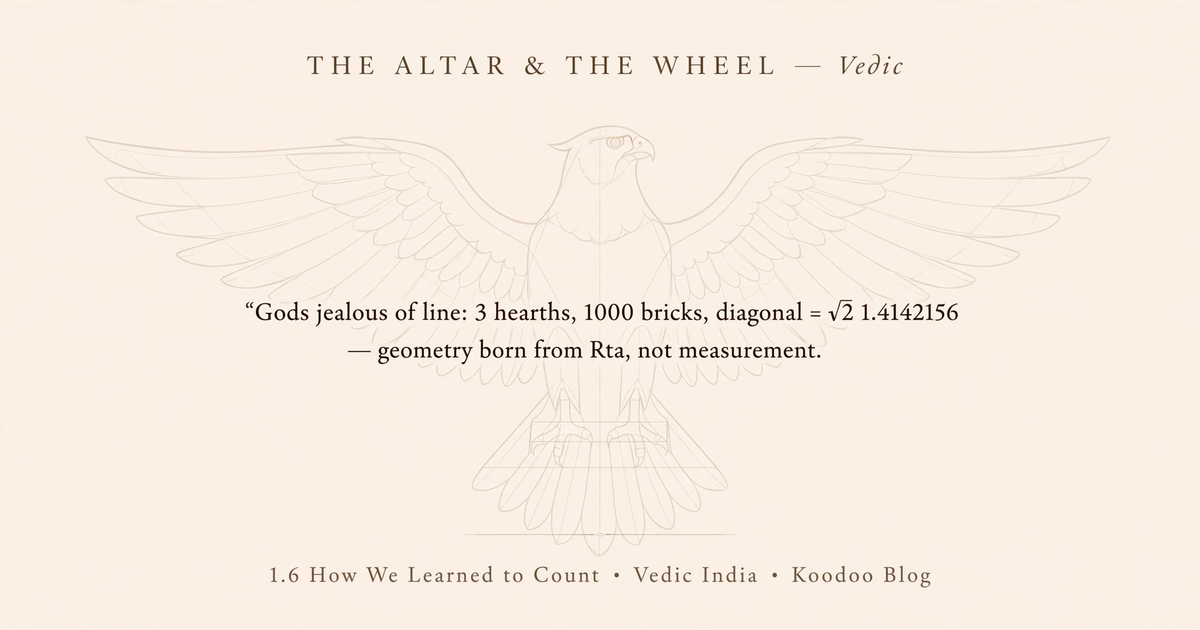
How does anyone take a circle traced on the ground with nothing but a wooden peg and a length of woven hemp rope and transform it into a square of identical area. That ancient problem of squaring the circle baffled the geometers of Athens centuries later, yet it faced the rope-stretchers of the Gangetic plain as a practical commission with cattle and harvests at stake. Baudhayana walked the clearing, drove a peg into the dirt, looped his cord around it, and formulated the first recorded statement of the diagonal theorem in human history, preserved as Sutra 1.48. His sentence declares that the cord stretched across the diagonal of an oblong produces both what the vertical and horizontal sides make separately, a truth he felt in the rope rather than proved through Greek deductive syllogisms. If a square has area one, he saw, then its diagonal produces a square of area two, and when a patron ordered an altar of doubled area without changing its proportions, the rope-stretcher had to calculate the square root of two to do the work.
Baudhayana looked at his cord, folded it into fractional divisions, and wrote an approximation of breathtaking precision that still startles engineers who test it against modern calculators.
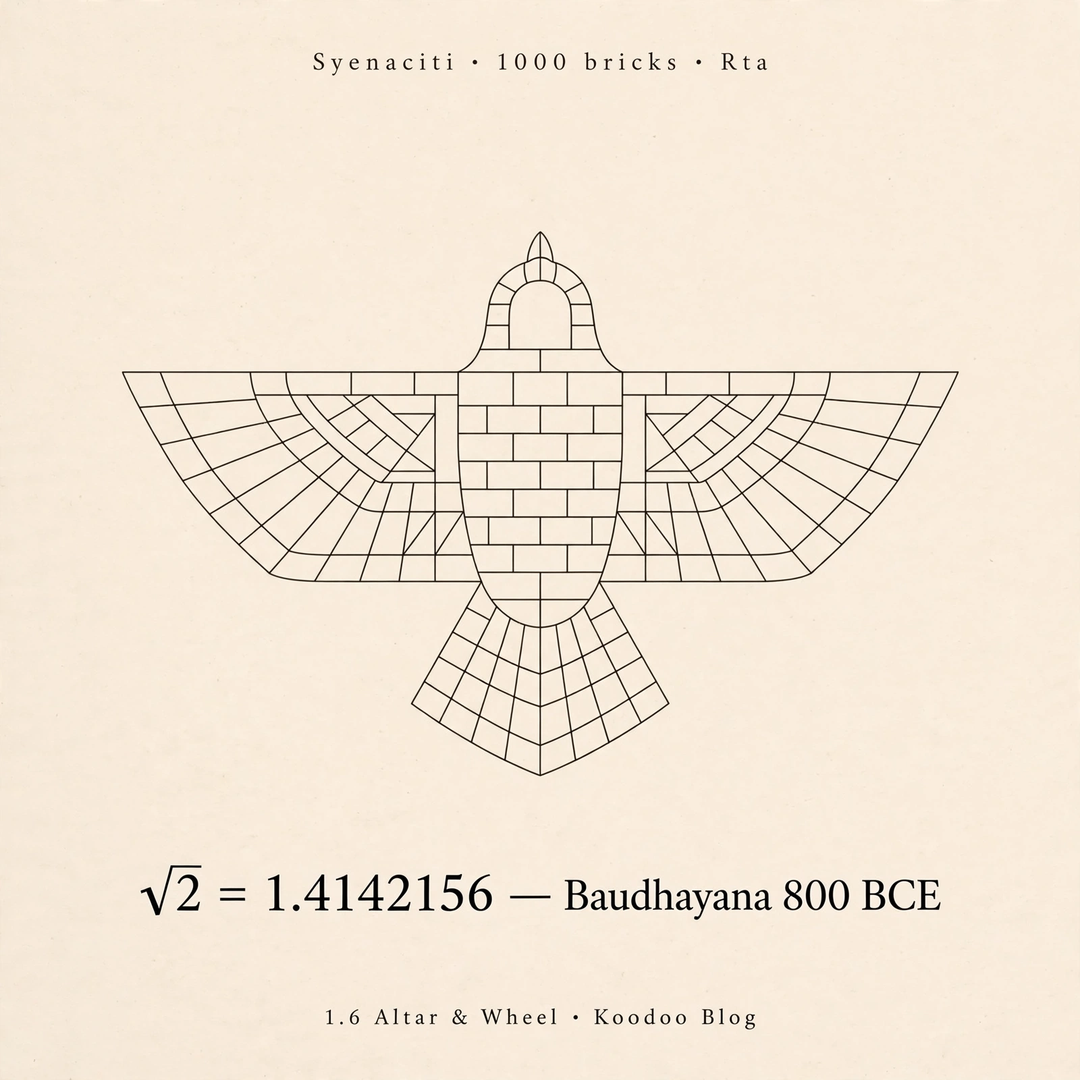
Converted from that ancient Sanskrit verse into modern decimal fractions, the recipe reads 1 plus 0.333333 plus 0.083333 minus 0.002451, which totals 1.4142156, while the true value of the square root of two to six decimals is 1.4142135. The rope-folding algorithm was accurate to five decimals and missed by less than two parts in a million, so if a mason stretched a rope across an altar forty feet wide using that formula, the error at the corner would be less than the thickness of a fingernail. Precision that fine, achieved with fiber and stakes, protected both the ritual and the reputation of the craftsmen who staked their livelihood on the line.
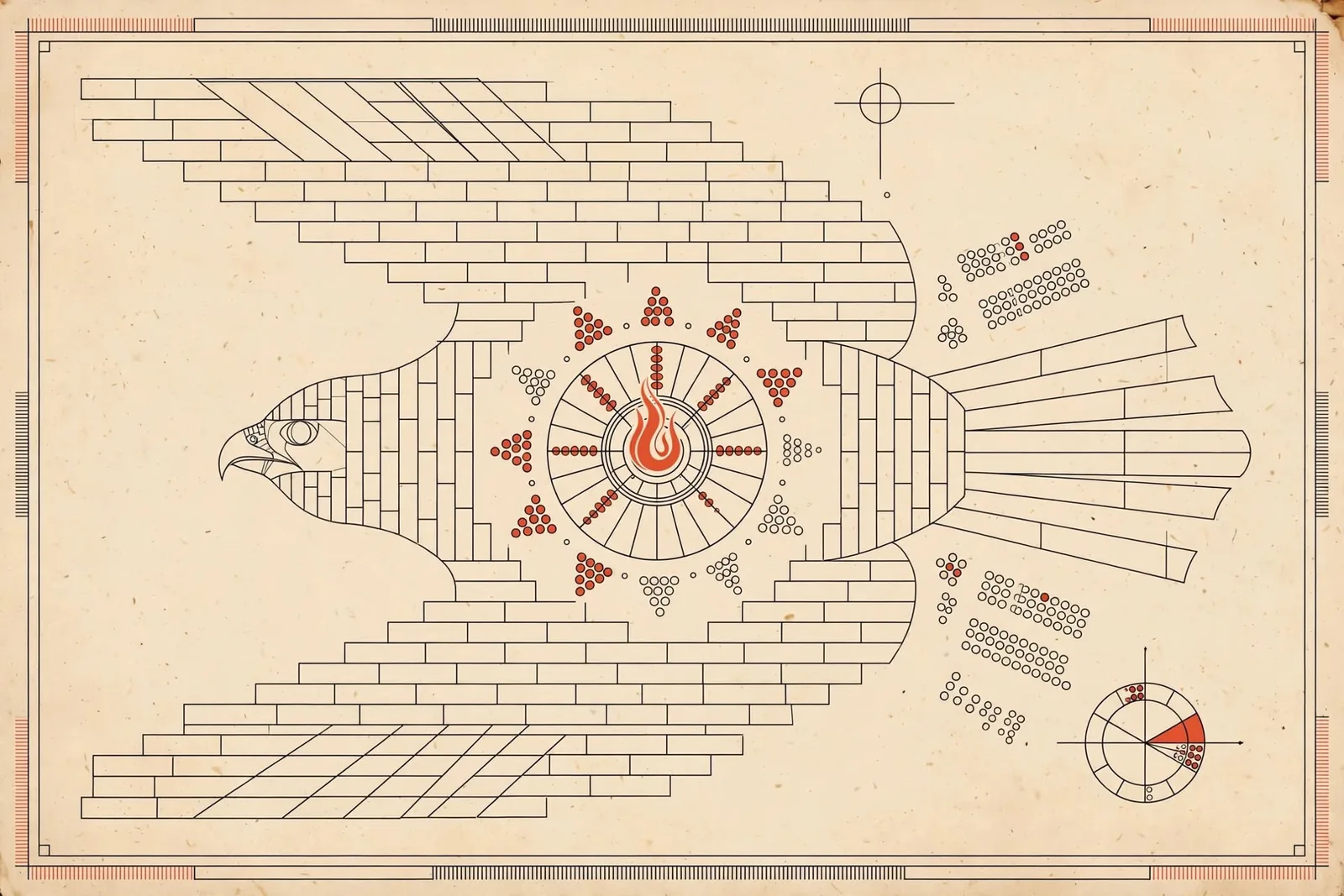
When a patron demanded the ultimate altar, the Syenaciti altar shaped like a falcon, Baudhayana and his successors assembled one thousand specially molded bricks into five complex layers that formed a curved beak and segmented wings and a sweeping tail, an airborne predator laid out on the grass. Yet down to the last grain of consecrated sand, its surface area still equaled the ancient primitive square of seven and one-half square purushas, preserving the ritual measure across a radical change of form. Geometry here was no set of dead definitions on parchment but a living bridge between the mud of the Gangetic plain and the rotating wheel of the stars.
Epilogue: The First Threshold of the Mind
Looking back across the vast sweep from the baboon bone of Ishango through the black silt of the Nile, across the cuneiform accounting houses of Uruk, past the polished chert weights of Harappa, and on to the sacred fire altars of the Ganga, one profound lesson about human thought stands stark and unvarnished. Number was never an academic invention dreamed up by scholars with leisure to play, because humanity did not begin with mathematics but with hunger and flood and fear and debt. People were driven into the arms of calculation by the ruthless friction of physical survival, and every abstraction in this volume still carries the fingerprints of the crisis that demanded it.
The story falls into five clear thresholds, and each one solved a harder problem of trust than the last. Around 20,000 before the common era came the discrete cut of the Paleolithic tally, when consciousness invented the first external storage unit by gouging notches into bone to freeze lunar time against biological forgetting. Around 3000 to 1550 came the broken reality of additive silt and unit fractions in Egypt, where the predictable solar clock of Ra forced the invention of land-surveying geometry and fractional loaf-splitting to preserve civic peace after every flood. Around 3200 to 1750 came the abstract gearbox of the positional base-sixty machine in Mesopotamia, where capricious rivers and corporate temple accounting collapsed clay tokens into cuneiform and forged the first positional calculating software. Around 2600 to 1900 came the empire of trust through the silent consensus of chert in the Indus Valley, where a continent-wide civilization standardized binary-decimal weights and one-to-two-to-four bricks, proving that numbers could create order without weapons. Around 1000 to 500 came the wheel of time and the geometry of area preservation in Vedic India, where addition was recognized as cosmic rotation and the fire altar became an astronomical computer that measured the square root of two.
Notice the grand and unbroken intellectual trajectory that began when human inquiry learned its first great skill, which was how to represent the world in discrete and manageable units. In that opening epoch, civilization learned how to count and weigh and divide fractions and measure the perimeter of a field, and each solution looked final in its own valley. Yet without knowing it, those ancient scribes planted the seeds of the greatest intellectual battles in history, battles that would culminate five thousand years later in the Seven Millennium Prize Problems that still test the limits of proof.
When the Egyptian scribe Ahmes struggled to divide seven loaves among ten men, he took the first step into the chasm between the discrete integer and the continuous continuum, a chasm that eventually leads to the Riemann Hypothesis about the discrete distribution of prime numbers governed by the continuous zeros of a complex wave. When Mesopotamian canal engineers watched the violent churning silt of a Tigris flood tear at their dykes, they confronted the terrifying and unsolved monster of fluid turbulence, a mystery that lives today as the unsolved Navier-Stokes Existence and Smoothness problem. When Babylonian accountants searched their reciprocal tables to divide silver debts without tedious division, they brushed against the boundary of computational complexity that became the ancestor of the P versus NP question, which asks whether checking an answer is fundamentally faster than finding one. When Baudhayana stretched his cord across the falcon altar and asked how a circle can be deformed into a square without tearing its surface, he took the first primitive step toward topology, a lineage that runs through Henri Poincaré to Grigori Perelman and the resolution of the Poincaré Conjecture. The ancient world owned no computers but worked with wet clay and twisted cords and stone balances, yet the road from the mud of the Nile to the silicon chips of the modern frontier is a single continuous line. The ghost that awakened when the first hunter notched a baboon bone is the same ghost that sits inside our machines today, looking back through five thousand years of fire and flood and still asking the eternal question of the seeking mind, which is what the true number of the universe might be.
A herder could leave his village and his son could still read the bone without hearing the story firsthand, and that handoff is why knowledge began to stack across generations instead of fading each winter. I grew up in Nanded hearing my grandmother count loaned grain on her fingers, using the same bone logic with a new hand and the same care that the Ishango carver brought to quartz and fibula. From notch to knot to clay to coin to bank to phone, one straight line runs through this entire history, and your database row is a tally notch with better clothes while your to-do tick is a small cut that would have made sense to the keeper by the fire.