Full article — Read the full 38-min monograph — this is a short 5-min part for LinkedIn/Instagram.
As the Harappan cities slowly dissolved around 1900 before the common era under the combined pressure of tectonic shifts and the drying of the Sarasvati River, the intellectual center of gravity in northern India migrated eastward into the lush rain-drenched forest clearings of the Gangetic plains. There, among Vedic clans, number returned to its sacred and cosmic origin in the sacrificial fire altar. To understand the mathematics of the Vedic world, a modern reader must abandon the Cartesian view of space as a cold empty stage, a passive three-dimensional grid extending indefinitely while observers plot points upon it.
The Vedic mind, formalized in the philosophical schools of Sankhya, which literally translates as enumeration and categorization by number, and in the hymns of the Rigveda, saw space not as emptiness but as a living and vibrating field governed by Rta, the immutable and rhythmic cyclical course of the cosmos. The universe was no machine assembled from dead parts but an unending revolving wheel of time called the Kala-Chakra. In the first mandala of the Rigveda, hymn 1.164.48, the seer Dirghatamas sings of that cosmic clock in words that still read like astronomy, saying the wheel carries twelve spokes and three navels and asking who can understand it, then adding that 360 pins are set in it and do not loosen in the least. Here the solar year of twelve months and three seasons and 360 days was understood not as a flat calendar on a wall but as a rotating wheel whose angular motion drives the life of the world.
Inside that cyclical cosmos, the fundamental operation was not moving forward along a line, because addition itself was rotation. When one day is added to thirty days, the count does not travel to a thirty-first day in empty space but completes a cycle of the moon and returns to the beginning. Time and energy and matter operated under the logic of cycles and remainders, a continuous traversal of angle driven by perpendicular momentum, so that just as an arrow shot horizontally across the sky curves beneath the perpendicular pull of gravity into a dynamic orbit, the universe stayed alive only because it kept spinning. Number therefore belonged to rhythm before it belonged to the straight ruler.
That dynamic rotational vision met the physical earth in the Sulba Sutras, the ancient manuals of ritual geometry attributed to master craftsmen such as Baudhayana and Apastamba and Katyayana around 800 to 500 before the common era. The word Sulba derives from the root sulv, meaning to measure or to rope, and the Sulba masters were heirs of both the Harappan bricklayers and the Vedic astronomers, architects who constructed the great Agnicayana fire altars. Their ritual mandate carried terrifying geometric rigidity, because a mistake in the altar was an offense against the order that held the seasons together.
”Gods are jealous of line. If altar earth transformed altar sky and its soil diminished breadth grain mustard sacrificer shall be stricken blindness or cattle shall perish night.”
— Apastamba Sulba Sutra Section IIA patron king or wealthy cattle chieftain who commissioned the great Agnicayana sacrifice to restore cosmic harmony and ensure the survival of his clan had to provide three distinct hearths burning through the night. The Garhapatya, the domestic fire of the householder, was built as an unbaked circular hearth representing the terrestrial Earth, while the Ahavaniya, the sacred fire of the eastern offering, was built as a strictly square hearth representing the celestial Heavens, and the Dakshinagni, the southern defensive fire, was built as a semi-circular crescent hearth standing as the atmospheric shield between them. Here arose the mathematical knot that gave birth to Indian geometry, because those three altars, despite their completely different shapes, were required to possess exactly the same surface area, traditionally one square purusha, the height of a man with arms upraised.
How does anyone take a circle traced on the ground with nothing but a wooden peg and a length of woven hemp rope and transform it into a square of identical area. That ancient problem of squaring the circle baffled the geometers of Athens centuries later, yet it faced the rope-stretchers of the Gangetic plain as a practical commission with cattle and harvests at stake. Baudhayana walked the clearing, drove a peg into the dirt, looped his cord around it, and formulated the first recorded statement of the diagonal theorem in human history, preserved as Sutra 1.48. His sentence declares that the cord stretched across the diagonal of an oblong produces both what the vertical and horizontal sides make separately, a truth he felt in the rope rather than proved through Greek deductive syllogisms. If a square has area one, he saw, then its diagonal produces a square of area two, and when a patron ordered an altar of doubled area without changing its proportions, the rope-stretcher had to calculate the square root of two to do the work.
Baudhayana looked at his cord, folded it into fractional divisions, and wrote an approximation of breathtaking precision that still startles engineers who test it against modern calculators.
Converted from that ancient Sanskrit verse into modern decimal fractions, the recipe reads 1 plus 0.333333 plus 0.083333 minus 0.002451, which totals 1.4142156, while the true value of the square root of two to six decimals is 1.4142135. The rope-folding algorithm was accurate to five decimals and missed by less than two parts in a million, so if a mason stretched a rope across an altar forty feet wide using that formula, the error at the corner would be less than the thickness of a fingernail. Precision that fine, achieved with fiber and stakes, protected both the ritual and the reputation of the craftsmen who staked their livelihood on the line.
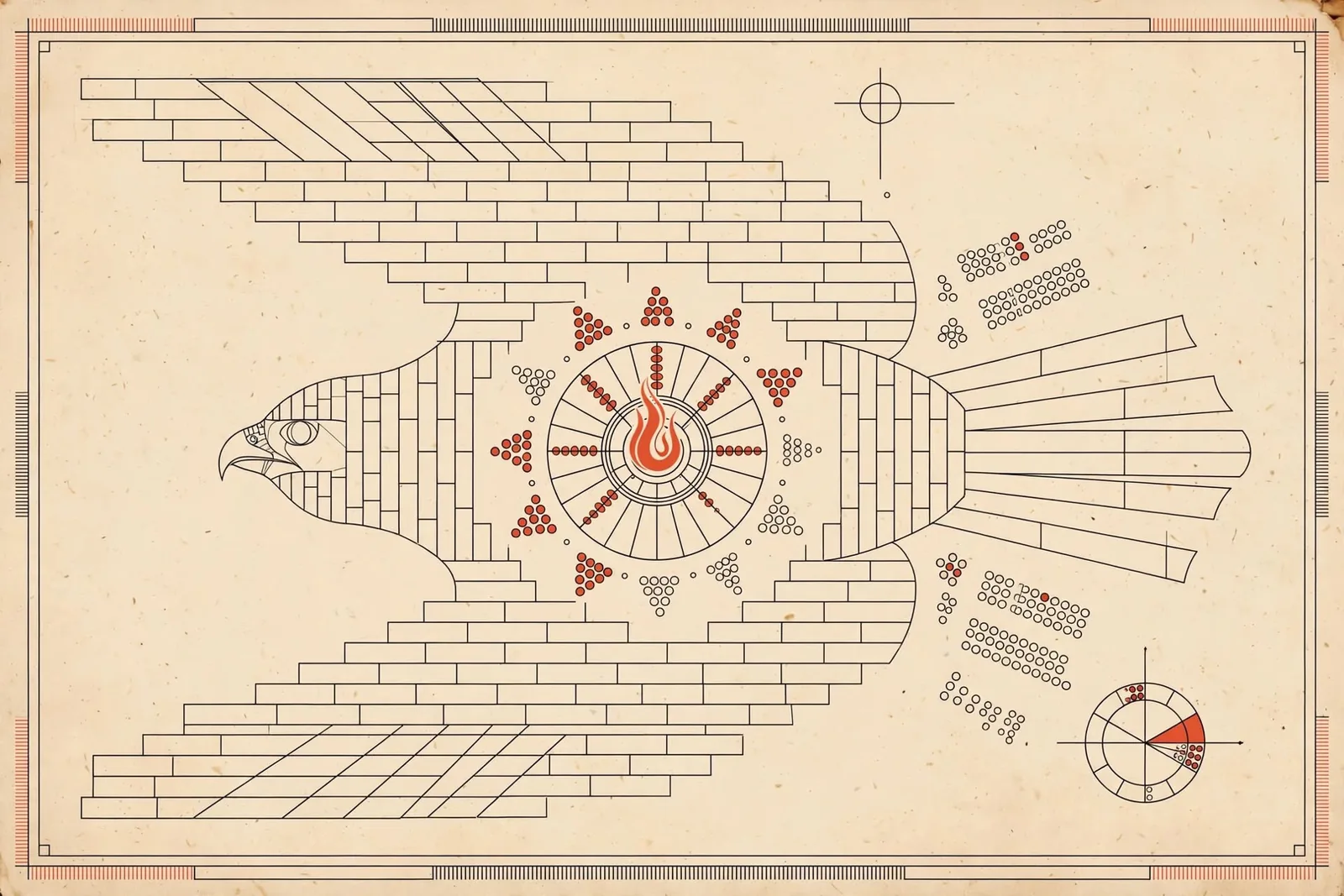
When a patron demanded the ultimate altar, the Syenaciti altar shaped like a falcon, Baudhayana and his successors assembled one thousand specially molded bricks into five complex layers that formed a curved beak and segmented wings and a sweeping tail, an airborne predator laid out on the grass. Yet down to the last grain of consecrated sand, its surface area still equaled the ancient primitive square of seven and one-half square purushas, preserving the ritual measure across a radical change of form. Geometry here was no set of dead definitions on parchment but a living bridge between the mud of the Gangetic plain and the rotating wheel of the stars.
The tally keeper nods: one cut, one moon, one debt remembered.
Looking back across the vast sweep from the baboon bone of Ishango through the black silt of the Nile, across the cuneiform accounting houses of Uruk, past the polished chert weights of Harappa, and on to the sacred fire altars of the Ganga, one profound lesson about human thought stands stark and unvarnished. Number was never an academic invention dreamed up by scholars with leisure to play, because humanity did not begin with mathematics but with hunger and flood and fear and debt. People were driven into the arms of calculation by the ruthless friction of physical survival, and every abstraction in this volume still carries the fingerprints of the crisis that demanded it.
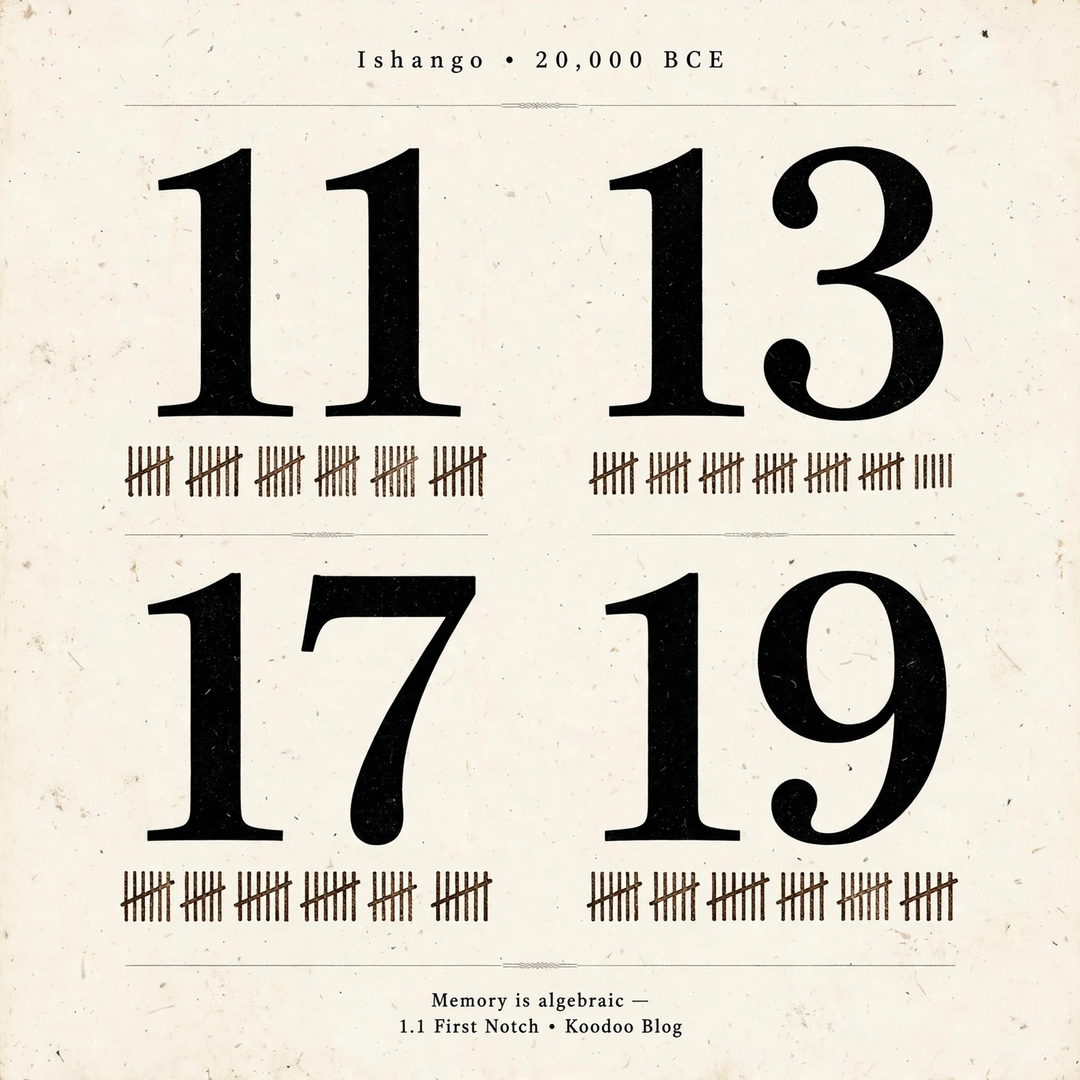
The story falls into five clear thresholds, and each one solved a harder problem of trust than the last. Around 20,000 before the common era came the discrete cut of the Paleolithic tally, when consciousness invented the first external storage unit by gouging notches into bone to freeze lunar time against biological forgetting. Around 3000 to 1550 came the broken reality of additive silt and unit fractions in Egypt, where the predictable solar clock of Ra forced the invention of land-surveying geometry and fractional loaf-splitting to preserve civic peace after every flood. Around 3200 to 1750 came the abstract gearbox of the positional base-sixty machine in Mesopotamia, where capricious rivers and corporate temple accounting collapsed clay tokens into cuneiform and forged the first positional calculating software. Around 2600 to 1900 came the empire of trust through the silent consensus of chert in the Indus Valley, where a continent-wide civilization standardized binary-decimal weights and one-to-two-to-four bricks, proving that numbers could create order without weapons. Around 1000 to 500 came the wheel of time and the geometry of area preservation in Vedic India, where addition was recognized as cosmic rotation and the fire altar became an astronomical computer that measured the square root of two.
Notice the grand and unbroken intellectual trajectory that began when human inquiry learned its first great skill, which was how to represent the world in discrete and manageable units. In that opening epoch, civilization learned how to count and weigh and divide fractions and measure the perimeter of a field, and each solution looked final in its own valley. Yet without knowing it, those ancient scribes planted the seeds of the greatest intellectual battles in history, battles that would culminate five thousand years later in the Seven Millennium Prize Problems that still test the limits of proof.
When the Egyptian scribe Ahmes struggled to divide seven loaves among ten men, he took the first step into the chasm between the discrete integer and the continuous continuum, a chasm that eventually leads to the Riemann Hypothesis about the discrete distribution of prime numbers governed by the continuous zeros of a complex wave. When Mesopotamian canal engineers watched the violent churning silt of a Tigris flood tear at their dykes, they confronted the terrifying and unsolved monster of fluid turbulence, a mystery that lives today as the unsolved Navier-Stokes Existence and Smoothness problem. When Babylonian accountants searched their reciprocal tables to divide silver debts without tedious division, they brushed against the boundary of computational complexity that became the ancestor of the P versus NP question, which asks whether checking an answer is fundamentally faster than finding one. When Baudhayana stretched his cord across the falcon altar and asked how a circle can be deformed into a square without tearing its surface, he took the first primitive step toward topology, a lineage that runs through Henri Poincaré to Grigori Perelman and the resolution of the Poincaré Conjecture. The ancient world owned no computers but worked with wet clay and twisted cords and stone balances, yet the road from the mud of the Nile to the silicon chips of the modern frontier is a single continuous line. The ghost that awakened when the first hunter notched a baboon bone is the same ghost that sits inside our machines today, looking back through five thousand years of fire and flood and still asking the eternal question of the seeking mind, which is what the true number of the universe might be.
A herder could leave his village and his son could still read the bone without hearing the story firsthand, and that handoff is why knowledge began to stack across generations instead of fading each winter. I grew up in Nanded hearing my grandmother count loaned grain on her fingers, using the same bone logic with a new hand and the same care that the Ishango carver brought to quartz and fibula. From notch to knot to clay to coin to bank to phone, one straight line runs through this entire history, and your database row is a tally notch with better clothes while your to-do tick is a small cut that would have made sense to the keeper by the fire.
Keep reading
This is one short part of the full 38-minute monograph. Nothing here is cut from the archive - the complete chapters live together in one place.
Read full 38-min monograph /first-notch/ - This is the final part.