Full article — Read the full 38-min monograph — this is a short 5-min part for LinkedIn/Instagram.
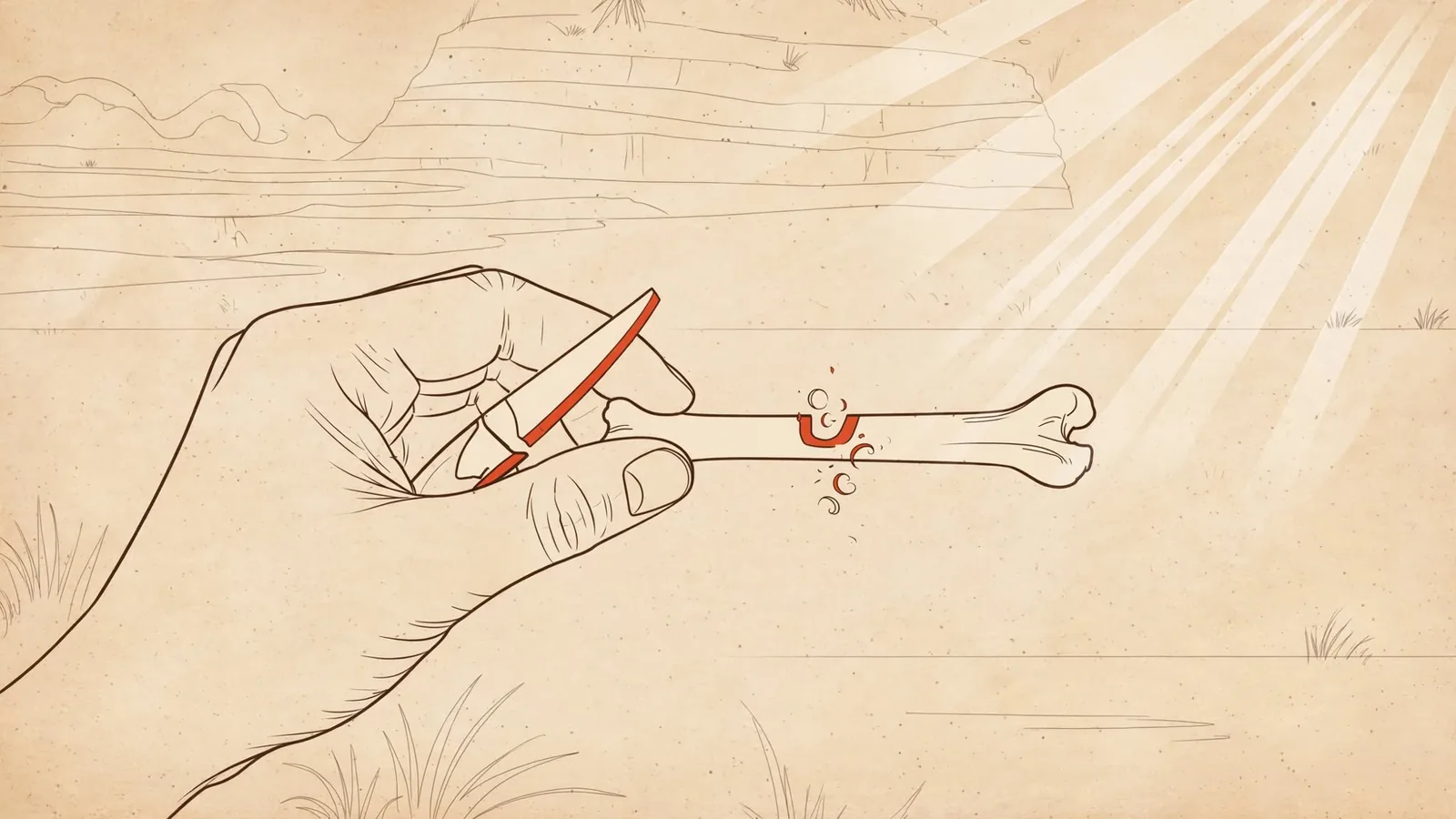
Twenty thousand years before the first merchant ship crossed the Persian Gulf, a human hand worked by the light of a dying fire in the high volcanic hills above Lake Edward, near the headwaters of the Nile, scraping a sharpened flake of quartz against the dark leg bone of a baboon. The wind blowing off the ice sheets of the European glaciers had chilled the central African highlands into dry scrub, and the herds were moving while the seasonal lakes shrank and the clan went hungry. Nobody in that camp was thinking about mathematics, because they were thinking about surviving the next week and keeping the children alive through the cold nights.
The bone survived because it was buried in volcanic ash at a fishing settlement called Ishango, and it was no ornament because it carried no pictures of antelopes or hunters. It carried three parallel columns of short cuts made with deliberate and uneven pressure, marks that were clearly counted rather than decorated. One column reads 11, 13, 17, and 19, the prime numbers between 10 and 20, while another column sets 3 beside 6, 4 beside 8, and 10 beside 5, pairings that show doubling and halving. Whoever carved those columns was keeping track of quantities that mattered, and the care in the spacing shows a mind working through relationships between numbers.
The bone was excavated in 1950 by the Belgian geologist Jean de Heinzelin, and scholars have debated ever since whether it was a tally, a calendar, or a game. That debate misses the harder truth, because no illiterate clan grinds quartz into bone for amusement while its children suffer from hunger and sickness. The carver worked because living memory had failed, and the group needed a record that would still be there in the morning when voices disagreed. The notches were cut under pressure, and pressure is the reason most of mathematics exists.
”Memory is algebraic; compute is transcendental. The living animal computes continuously through senses—heat wind scent predator arc spear. But computation vanishes with breath. Bone is first time animal refused to let calculation die.”
— Reflection on Paleolithic MetrologyBefore the notch, life ran on fragile memory carried inside the skull, and that fragility shaped every decision the clan made. A woman tracking the cycles of her own body and the shedding of blood had to carry that calendar of the moon entirely in her head, and a fever could wipe the count clean in a single night. When the herd passed through the mountain gap on the dark of the moon, hunters who arrived ten days late found an empty valley, and a winter camp without stored food could become a tomb of unburied bones. Forgetting was not embarrassment but death, and every elder knew how quickly a season could turn against a forgetful group.
The notch became the first unit of external storage ever built by a land-dwelling mind, and it was an act of rebellion against the endless flow of nature. The universe does not hand us whole numbers, because nature deals in shifting light and temperature and hunger that rise and fall without clean edges. By hacking a line into a baboon leg, the carver made a sharp discrete cut across that continuous reality and declared that this moon is one and the next is two. That frozen interval, held in dead matter, could be pointed at and argued over and trusted in a way that breath and speech never allowed.
Yet the notch could only count what already existed in front of the counter, and that limit would drive the next ten thousand years of invention. Nobody can notch a bone for an empire that has not yet been taxed, and nobody can settle a harvest by scratching lines when the task is dividing 500 bushels of grain among 47 canal diggers. The same tool cannot measure the cubic cubits of limestone in a ramp climbing toward the sky, nor can it settle a debt between two men who speak different languages. To answer those harder demands, humanity had to leave the frozen ridges and descend into the thick mud of the great river valleys.
Keep reading
This is one short part of the full 38-minute monograph. Nothing here is cut from the archive - the complete chapters live together in one place.
Read full 38-min monograph /first-notch/ - Read next part: /first-notch-egypt-sun-on-silt/